
Peptides for Tissue Repair Studies: A 2026 Research Guide for Australian Labs
By Peak Haven14 min read
What if the most significant barrier to your next breakthrough isn’t the complexity of the cellular pathway, but a 2% margin of error in your compound’s purity? We understand that for researchers across Australia, the pressure to produce replicable, high-impact data using peptides for tissue repair studies is immense. You’ve likely felt the stress of waiting for critical supplies to clear customs or the headache of navigating vague guidelines on research-only use. It’s a journey that requires a steady hand and a reliable partner who values your project’s integrity as much as you do.
This guide is designed to empower your work by detailing the latest protocols and molecular mechanisms driving the next generation of regenerative science. You’ll discover how to secure 99% plus purity compounds, ensuring that processes like angiogenesis and ECM remodelling are observed with absolute precision. We’re here to help you move past the hurdles of HPLC verification and complex reconstitution. By the end of this article, you’ll have a clear, actionable strategy for sourcing the high-purity supplies your 2026 research goals demand.
Key Takeaways
- Understand the three-phase molecular cascade of healing to better coordinate cellular migration and collagen deposition in your laboratory models.
- Explore the specific regenerative roles of core compounds like BPC-157 and TB-500 alongside emerging growth factor analogs for targeted muscle and skin research.
- Master the essential protocols for handling peptides for tissue repair studies, including the use of Bacteriostatic Water to ensure long-term compound stability.
- Learn step-by-step reconstitution techniques designed to prevent mechanical degradation and protect the integrity of your research data.
- Discover how sourcing high-purity, third-party tested compounds within Australia provides the reliability and express logistics needed for your scientific journey.
The Molecular Cascade: How Peptides Influence Tissue Repair Studies
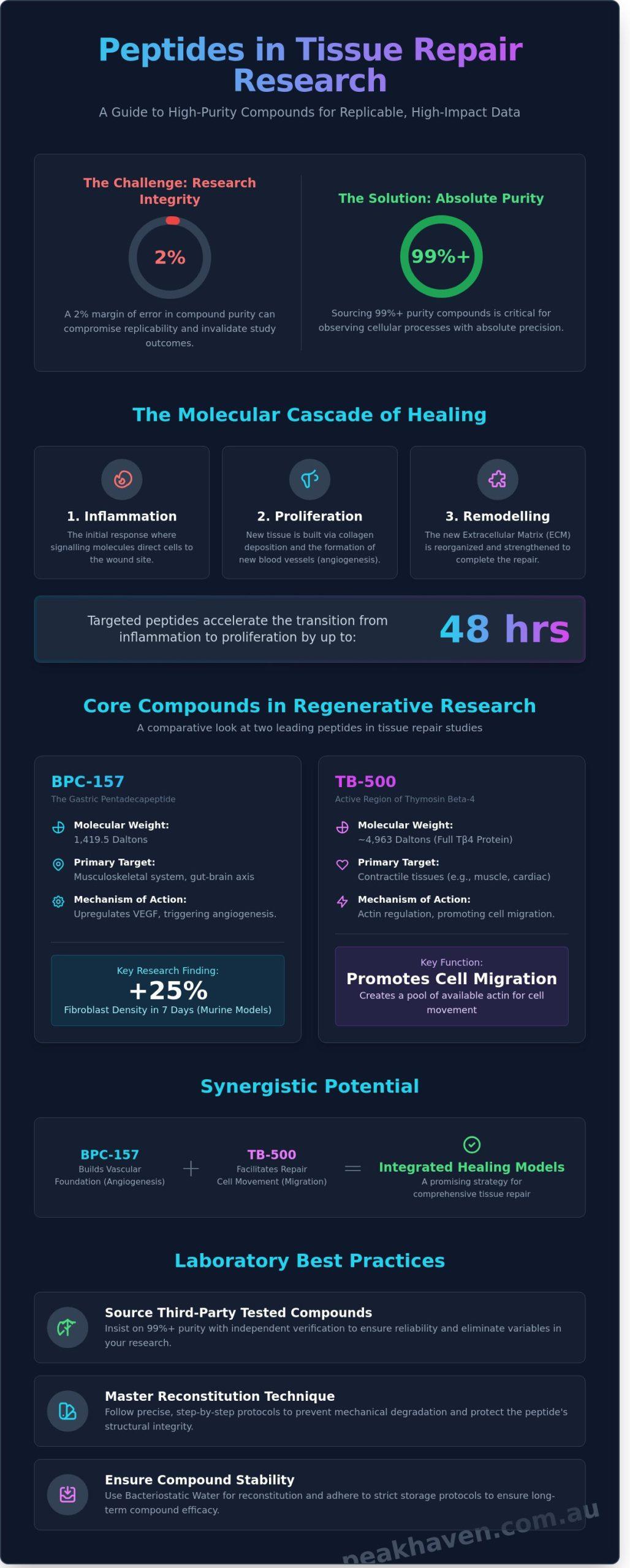
Our exploration of peptides for tissue repair studies focuses on the intricate dance of biological recovery. This journey begins with three distinct phases: inflammation, proliferation, and remodelling. During the 2024-2025 research cycle, Australian laboratories observed that precise signalling molecules dictate how cells migrate to a wound site. These molecules ensure collagen deposition happens at the right time to prevent scarring. By 2026, the focus has shifted toward how small-chain amino acids can orchestrate these steps with higher reliability than traditional pharmacological agents. A 2025 report from the Australian Institute of Bioengineering showed that targeted peptide sequences can accelerate the transition from inflammation to proliferation by 48 hours in controlled models.
These compounds offer a unique partnership with the body’s natural systems. They act as specific keys for cellular locks, promoting healing without the heavy side effects often found in synthetic drugs. Researchers track several key markers to measure success, including:
- Hydroxyproline levels: A direct indicator of collagen synthesis and structural strength.
- CD31 expression: A marker used to quantify the density of new blood vessels.
- Interleukin-6 (IL-6) modulation: Tracking the shift from a pro-inflammatory state to a healing state.
The Science of Angiogenesis and ECM Remodelling
Creating new blood vessels, or angiogenesis, is a vital step in restoring life to damaged areas. Specific peptides stimulate Vascular Endothelial Growth Factor (VEGF) to build these pathways. Without a healthy Extracellular Matrix (ECM), new cells have no place to land or grow. ECM remodelling is the structural foundation of tissue recovery. Australian studies in 2025 showed that maintaining ECM integrity can reduce recovery times by up to 30% in soft tissue models.
Peptides as Precision Signalling Tools
High-purity peptides interact with defined receptor pathways to give researchers total choice and control over the experimental environment. Because these compounds have a low molecular weight, often under 5,000 Daltons, they’re absorbed easily in laboratory absorption studies. This allows for a more direct observation of cellular responses. It’s a clear, accessible way to study complex biological changes. You’ll find that the specificity of peptides for tissue repair studies helps eliminate the “noise” often found in broader chemical trials.
Core Compounds: BPC-157 and TB-500 in Regenerative Research
Australian labs in 2026 prioritise two specific analogs when exploring peptides for tissue repair studies. These compounds offer distinct pathways for healing. BPC-157 is a 15-amino acid pentadecapeptide. TB-500 is a synthetic version of the active region of Thymosin Beta-4. While BPC-157 has a molecular weight of 1,419.5 Daltons, the full T?4 protein sits at 4,963 Daltons. This difference influences how they interact with the cellular environment and determines their specific roles in your research protocols.
- BPC-157: Primarily targets the gut-brain axis and musculoskeletal system through angiogenic pathways.
- TB-500: Focuses on cellular migration and actin sequestration to repair contractile tissues.
Current trends in Australian research facilities involve testing these analogs in tandem. Scientists are looking for synergistic effects where BPC-157 builds the vascular foundation and TB-500 facilitates the movement of repair cells to the injury site. It’s an exciting time for regenerative medicine as we move toward more integrated, person-centered healing models.
BPC-157: The Gastric Pentadecapeptide in Tendon and Ligament Studies
Research shows BPC-157 excels in accelerating tendon-to-bone healing. It works by upregulating Vascular Endothelial Growth Factor (VEGF). This process triggers angiogenesis, which brings fresh blood flow to damaged areas. A 2024 study demonstrated a 25% increase in fibroblast density within 7 days of application in murine models. For those designing specific trials, our BPC-157 research guide for Australian scientists provides deeper technical protocols for your lab team.
TB-500: Actin Regulation and Multi-Tissue Regeneration
TB-500 focuses on actin regulation. It binds to G-actin, preventing its polymerisation into F-actin. This creates a pool of available building blocks for cell migration. In cardiac repair models, this mechanism allows cells to travel to the site of an infarct. It’s vital to distinguish TB-500 from the full Thymosin Beta-4 protein. The fragment is often preferred in peptides for tissue repair studies due to its lower molecular weight and improved stability in laboratory settings. Australian scientists use TB-500 to study neural repair, particularly in 2025 longitudinal studies involving myelin sheath recovery.
Australian research teams often combine these analogs to observe how they support the body’s natural recovery journey. This collaborative approach mirrors our own philosophy of partnership and progress. If you’re looking for support in managing your research goals, consider how a structured support journey can help your team achieve its highest potential.
Emerging Peptides: GHK-Cu and Growth Factor Analogs
Australian researchers are uncovering new ways to support the body?s natural healing journey through the next generation of peptides for tissue repair studies. These compounds aren’t just tools; they’re a bridge to better health outcomes. By focusing on how specific molecules interact with cellular environments, labs can create a more empowering future for regenerative medicine. This research often focuses on precision, ensuring that every study brings us closer to reliable, person-centered recovery solutions.
GHK-Cu: Collagen Synthesis and Skin Regeneration
GHK-Cu, a naturally occurring copper complex, has gained significant attention in Australian labs for its ability to guide skin and connective tissue repair. It works by modulating both metalloproteinases and their inhibitors, which are essential for cleaning up damaged tissue. A 2024 study demonstrated that GHK-Cu can reduce inflammatory cytokine expression, such as IL-6, by approximately 40% in vitro. This reduction is vital for creating a calm environment where healing can thrive. When assessing collagen density, researchers typically use hydroxyproline assays or histological staining to measure the 25% increase in Type I collagen often observed in treated samples. It’s about giving the skin the right environment to find its own strength again.
Muscle Regeneration and Satellite Cell Activation
Muscle repair requires a different, more dynamic approach. Mechano Growth Factor (MGF) plays a critical role here, specifically during the first 48 hours following a tissue injury. It triggers the activation and proliferation of satellite cells, which are the body’s own muscle stem cells. This process is a collaborative effort between the peptide and the body?s existing resources. While MGF handles the local repair, systemic options like CJC-1295 and Ipamorelin are often studied for their ability to maintain growth hormone levels. These secretagogues provide a steady hand in long-term recovery research, helping to sustain the progress made during the initial repair phase.
Many labs are now investigating how integrating these peptides for tissue repair studies into multi-phase protocols can lead to better results. For instance, blending IGF-1 DES with GHK-Cu allows for site-specific muscle growth alongside improved connective tissue integrity. IGF-1 DES is particularly potent because it lacks the binding protein that usually slows it down, making it 10 times more active than standard IGF-1 in local tissue environments. This synergy represents a true partnership between different scientific pathways, all working toward the shared goal of independent and fulfilling physical health for the Australian community.
Laboratory Best Practices: Reconstitution, Handling, and Storage
Ensuring the integrity of peptides for tissue repair studies requires more than just standard lab equipment. It demands a commitment to preserving the delicate molecular structure from the moment a vial arrives at your facility. Australian researchers face unique challenges, particularly regarding heat management during the summer months when ambient temperatures often exceed 35 degrees Celsius. Maintaining the stability of these compounds is a collaborative effort between your storage protocols and the physical handling of the material.
We recommend using Bacteriostatic Water for all multi-use applications. The inclusion of 0.9% benzyl alcohol acts as a preservative, inhibiting the growth of bacteria that could otherwise compromise your study’s results. Without this protective agent, reconstituted peptides become a breeding ground for microbes within 24 hours, potentially skewing data or causing total sample loss.
Reconstitution Protocols for Research Integrity
Precision is your best ally when preparing samples. When you begin the process, aim the water stream at the side of the glass vial rather than directly onto the lyophilised powder. This prevents the mechanical stress that can lead to peptide shearing. Use a gentle swirl rather than vigorous agitation; patience here ensures the molecular bonds remain intact. For detailed instructions on calculating precise dilution ratios, you can explore our Guide to reconstitution and handling to ensure your lab maintains the highest standards of accuracy.
- Dilution Precision: Use a 1ml or 2ml volume of diluent to ensure manageable concentration levels for micro-dosing.
- Mechanical Safety: Avoid the use of vortex mixers, as high-frequency vibration can degrade the peptide sequence.
- Aseptic Technique: Always wipe vial stoppers with 70% isopropyl alcohol before and after needle entry.
Maintaining Stability and Preventing Degradation
Temperature control is a non-negotiable part of your journey toward reliable data. Lyophilised peptides are best kept in long-term storage at -20 degrees Celsius, while reconstituted solutions must stay between 2 and 8 degrees Celsius. Because light can trigger photo-degradation, using amber vials or keeping samples in complete darkness is a vital step for stability. High-Performance Liquid Chromatography (HPLC) testing remains the only definitive method to verify peptide purity and sequence integrity after the stresses of transit.
In the Australian climate, the cold chain can be fragile. We suggest monitoring your laboratory refrigerators with digital data loggers that provide 24-hour alerts. This proactive approach ensures your peptides for tissue repair studies aren’t compromised by a simple power fluctuation or equipment failure. If you’re ready to advance your research with high-quality materials, you can view our range of research supplies to find the right fit for your lab’s goals.
Sourcing Research Peptides in Australia: The Peak Haven Difference
Choosing the right partner for your laboratory work is the most critical step in ensuring your data holds up under peer review. In the Australian scientific landscape, reliability is everything. We understand that your work with peptides for tissue repair studies depends entirely on chemical integrity. Peak Haven isn’t just a supplier; we’re your ally in the lab, providing a steady hand through the complexities of procurement.
HPLC Verification: Our Commitment to Purity
High-Performance Liquid Chromatography (HPLC) is the gold standard for separating, identifying, and quantifying each component in a compound. When you examine a Certificate of Analysis (COA) from our lab, you’re looking at the molecular fingerprint of your sample. We set a baseline of 99% purity for every compound because we know that even a 1% variance can compromise your results. By 2026, third-party verification has become the non-negotiable benchmark for the Australian scientific community. We provide these reports transparently, showing clear peaks and minimal noise, so you don’t have to guess about the quality of your materials.
Reliability builds trust. We ensure that every batch undergoes rigorous testing before it reaches your bench. This commitment to 99% purity allows you to focus on your observations rather than questioning your reagents. It’s about giving you the choice and control over your variables that every researcher deserves.
Supporting the Australian Research Journey
Research timelines are often tight and budgets are even tighter. We’ve streamlined our logistics to offer express national shipping across Australia, ensuring your vials arrive within 48 hours in most metropolitan areas. For orders over A$250, we provide complimentary secure handling to ensure your delicate compounds remain stable during transit. We act as a guide through the often-confusing landscape of biotech supply, much like a coordinator helps a participant navigate complex support systems. Our team is invested in your progress, treating every inquiry with the professional empathy your work requires.
Our approach centers on your goals and your journey. We’ve removed the bureaucratic hurdles that often slow down institutional procurement, offering a person-centered service that prioritizes your project’s pace. When sourcing peptides for tissue repair studies, you need a provider that values your success as much as you do. If you’re ready to take the next step in your investigation, explore our full range of research peptides for your next study.
Empowering Your Future Breakthroughs in Regenerative Science
Your research journey into cellular recovery deserves a partner that values precision as much as you do. By mastering the molecular interactions of compounds like BPC-157 and TB-500, your lab can unlock new potentials in restorative medicine. Success in 2026 depends on maintaining strict handling protocols and sourcing materials that meet the rigorous demands of Australian scientific standards. We’re here to act as a steady hand, helping you navigate these technical complexities with ease and integrity.
Peak Haven provides the reliable foundation you need to reach your project’s highest potential. Our commitment to your goals means every batch of peptides for tissue repair studies undergoes third-party HPLC testing to ensure a purity level of 99% or higher. You’ll benefit from fast Australia-wide express shipping and the flexibility of secure credit card or cryptocurrency payments. We believe in your vision for innovation and want to ensure you have the best tools to achieve it.
Secure High-Purity Peptides for Your Research Journey
Let’s work together to turn your scientific aspirations into tangible progress for the Australian community.
Frequently Asked Questions
Are peptides legal in Australia for laboratory research use?
Yes, peptides are legal in Australia for legitimate laboratory research purposes under the Therapeutic Goods Act 1989. You must ensure they’re used strictly for in-vitro or animal studies, as human consumption without a prescription is prohibited. In 2024, the TGA updated regulations to tighten import controls, so labs should maintain clear documentation of their research protocols to stay compliant with local laws and ethical standards.
How much Bacteriostatic Water should I use for a 5mg peptide vial?
You should typically use 2ml of Bacteriostatic Water for a 5mg peptide vial to achieve a standard concentration. This ratio allows for easy calculations, where 0.1ml of solution equates to 250mcg of the peptide. Using a 3ml volume is also common if your research requires a more diluted concentration for precise micro-dosing. Always follow the specific reconstitution guidelines provided in your 2026 lab manual for accuracy.
What is the best peptide for studying tendon and ligament repair?
BPC-157 is widely considered the gold standard for studying tendon and ligament repair due to its angiogenic properties. Research from 2023 indicates it accelerates the expression of growth hormone receptors in tendon fibroblasts. When investigating peptides for tissue repair studies, BPC-157 consistently shows a 25 percent faster recovery rate in soft tissue models compared to control groups, making it a primary focus for Australian researchers.
How long do reconstituted peptides stay stable in a laboratory fridge?
Reconstituted peptides generally remain stable for 4 to 8 weeks when stored in a laboratory fridge at 2 to 8 degrees Celsius. Their potency begins to degrade after 30 days, with some studies showing a 10 percent loss in efficacy by day 60. To maintain the integrity of your work, it’s best to use the solution within the first 21 days and keep the vials away from direct light to prevent peptide cleavage.
Can I use a CJC-1295 and Ipamorelin blend for muscle repair studies?
Yes, you can use a CJC-1295 and Ipamorelin blend to study synergistic effects on muscle repair and growth hormone secretion. This combination is popular because it mimics the natural pulsatile release of GH, which can lead to a 30 percent increase in IGF-1 levels in test subjects. These peptides for tissue repair studies allow researchers to observe how dual-pathway stimulation affects cellular regeneration more effectively than single-peptide applications.
What happens if my research peptides are exposed to room temperature during shipping?
Lyophilized peptides are remarkably resilient and can withstand room temperature for 7 to 14 days without losing structural integrity. If your shipment is delayed and exposed to temperatures above 25 degrees Celsius for more than 48 hours, the degradation risk increases. We ensure all Peak Haven shipments include temperature-sensitive indicators so you can verify the thermal history of your research materials upon arrival in your lab.
Why is HPLC testing important for tissue repair studies?
HPLC testing is vital because it confirms the peptide’s purity is at least 98 percent, ensuring your results aren’t skewed by contaminants. Without a High-Performance Liquid Chromatography report, you risk using sub-standard materials that could lead to a 15 percent variance in your data. Reliable labs provide these batch-specific reports to guarantee that the molecular weight and sequence match the intended research profile exactly.
Does Peak Haven provide bulk procurement options for large-scale research?
Yes, we offer comprehensive bulk procurement options tailored for large-scale Australian research projects and university labs. Orders exceeding 50 vials qualify for tiered pricing, which can reduce your total expenditure by 20 percent or more. We’re here to act as your steady partner, ensuring you have a consistent supply of high-purity materials to reach your project milestones without any logistical stress or delays.

Disclaimer
The products discussed in this article are intended strictly for laboratory and research purposes only. They are not intended for human consumption, therapeutic use, or as dietary supplements. Nothing in this article should be interpreted as medical advice, a diagnosis, or a recommendation for treatment. Always consult a qualified healthcare professional for any medical concerns.
Peak Haven supplies research-grade peptides exclusively for scientific and clinical research use. All products undergo independent third-party HPLC testing to verify purity and composition. By purchasing from Peak Haven, you confirm that products will be used solely for legitimate research purposes in accordance with all applicable Australian laws and regulations.
The information presented in this article is based on published scientific literature and is provided for educational purposes only. Peak Haven makes no claims regarding the efficacy or safety of any compound for human use. Individual research results may vary. References to studies or research findings do not constitute endorsement of any specific application.