

What Does HPLC Tested Mean for Peptides? A Guide for Australian Researchers
By Peak Haven11 min read
Could an invisible impurity in your peptide vial be the silent variable that invalidates months of laboratory work? When you’re sourcing compounds for scientific study, purity isn’t just a technical requirement; it’s the foundation of your data’s integrity. Many researchers find themselves asking, what does hplc tested mean for peptides, and why is it considered the non-negotiable standard for quality control? At Peak Haven, we view ourselves as your dedicated ally in the lab, providing the steady hand and transparent data you need to reach your highest research potential.
You already know that even a minor deviation in compound identity can lead to inconsistent results or compromised cellular studies. Whether you are looking to buy BPC-157 Australia or investigating GHK-Cu benefits for research, the precision of your reagents determines the success of your project. We’re here to help you move past the stress of confusing lab reports and provide the clarity you deserve, especially when designing complex peptide stacks for research or sourcing pharmaceutical grade peptides. This guide will walk you through the HPLC process, explain how to decode a Certificate of Analysis, and ensure you have total confidence when you source materials for your next project.
Key Takeaways
- Master the technical basics of High-Performance Liquid Chromatography and how it separates compounds to ensure your research materials are precisely what they claim to be.
- Learn exactly what does hplc tested mean for peptides so you can identify the standard of purity required to protect your laboratory data from unexpected variables.
- Gain the practical skills to read a Certificate of Analysis (COA), allowing you to interpret chromatogram peaks and integration tables with professional confidence.
- Understand why consistent purity levels of 98% or higher are essential for the reproducibility of scientific studies across Australia.
- Discover how to source third-party verified research peptides with the added benefit of reliable, local shipping from a trusted Australian partner.
The Science of Purity: What is HPLC Testing for Peptides?
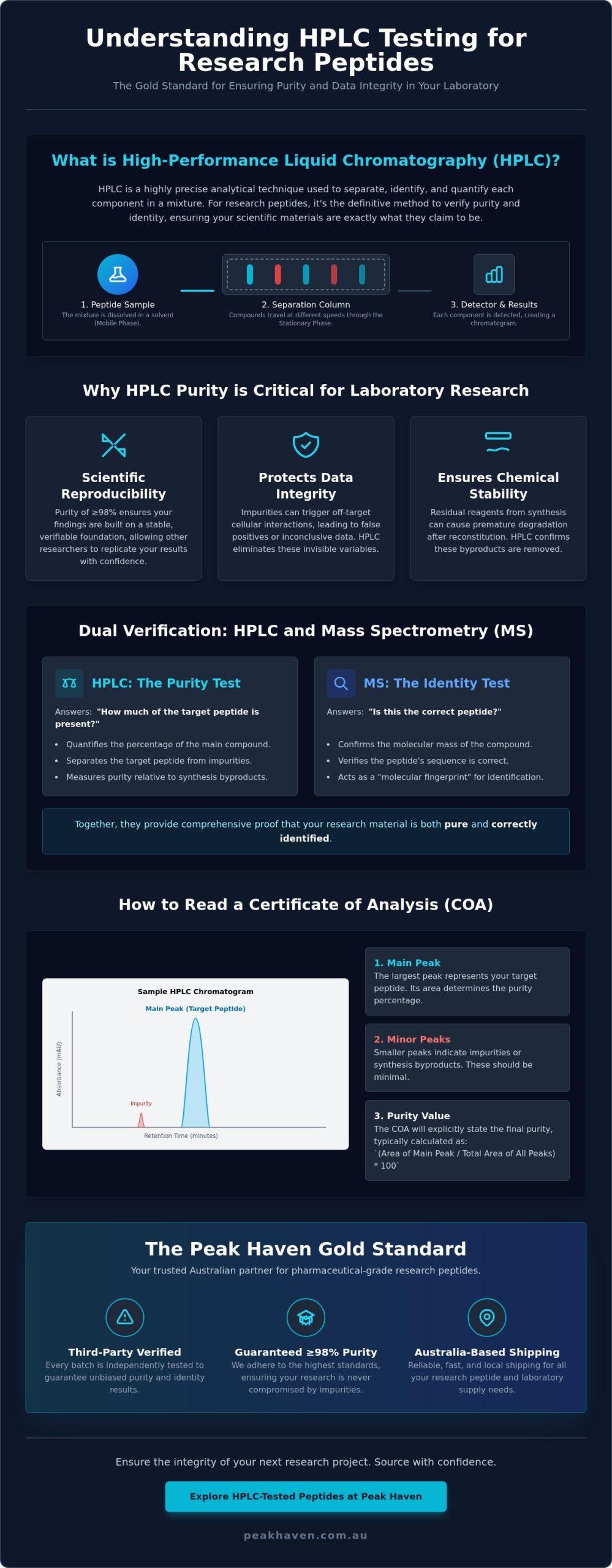
Understanding what does hplc tested mean for peptides starts with recognizing it as the gold standard for analytical chemistry in the laboratory. It’s a sophisticated method used to separate, identify, and quantify each component within a liquid mixture. In the context of research peptides Australia, this process ensures that the vial you receive contains exactly what the label specifies. By using High-performance liquid chromatography (HPLC), laboratories can detect even trace amounts of impurities that might otherwise compromise your study results.
The mechanism is elegantly simple yet highly precise. A liquid solvent, known as the mobile phase, carries the peptide through a column packed with solid adsorbent material, called the stationary phase. Different molecules interact with the adsorbent at varying intensities, causing them to move through the column at different speeds. This duration is known as “retention time.” Because every peptide sequence has a unique retention time under specific conditions, it acts as a molecular fingerprint to verify the compound’s identity.
To better understand this concept, watch this helpful video:
The Difference Between HPLC and Mass Spectrometry
While HPLC is excellent for measuring purity, it works best when paired with Mass Spectrometry (MS). HPLC tells us exactly how much of the target substance is present relative to any leftover reagents or side products. In contrast, MS confirms the actual identity of the molecule by measuring its specific molecular mass. For high-stakes research, a comprehensive laboratory report should include both to prove the compound is both pure and correctly sequenced. This dual verification provides a steady hand of reliability for your experiments.
Why Lyophilisation Requires Post-Production Testing
The final stage of production for compounds like Retatrutide 20mg involves lyophilisation, or freeze-drying. This process is essential for long-term stability and ease of transport, yet it’s also a stage where contaminants or degradation can occur if environmental controls aren’t perfect. Testing after this step is the only way to ensure the final product remains uncompromised for your study. HPLC serves as the gatekeeper of pharmaceutical-grade research supplies.
Why HPLC Tested Peptides are Critical for Laboratory Research
Scientific reproducibility is the heartbeat of credible research. When you ask what does hplc tested mean for peptides, you’re really asking how to eliminate the invisible variables that lead to false positives or inconclusive data. Impurities can trigger off-target cellular interactions, making it impossible to isolate the specific effects of the peptide sequence you’re studying. By insisting on 98% or higher purity, you ensure your findings are built on a stable, verifiable foundation that other researchers can replicate with confidence.
Chemical stability is equally vital for long-term study protocols. Residual reagents or synthesis byproducts can cause premature degradation once you introduce bacteriostatic water for reconstitution. This doesn’t just compromise the compound; it leads to significant laboratory waste and lost time. Sourcing research peptides Australia wide shouldn’t feel like a gamble. It should feel like a collaborative step toward accurate discovery, where the quality of your materials is a given rather than a question mark.
The Risks of Non-Verified Research Compounds
The global market often presents challenges with under-dosed or mislabelled compounds that can derail a study before it begins. Without third-party verification, researchers are left vulnerable to suppliers who don’t prioritize scientific integrity. A rigorous HPLC report acts as a shield, confirming the mass of the peptide in the vial matches your requirements. We understand the stress of navigating these complex systems, which is why we advocate for total transparency in every batch we provide to the Australian research community.
Achieving Pharmaceutical Grade Standards
In a professional laboratory setting, the distinction between common research chemicals and pharmaceutical grade peptides is often the difference between a breakthrough and a setback. Achieving 99% purity requires rigorous Peptide Mapping and Amino Acid Analysis to ensure the molecular structure is perfect. This analytical rigour provides a steady hand in a complex system, allowing you to focus on your aspirations for scientific progress. You can explore our HPLC-tested research peptides to find the reliable tools your laboratory needs to reach its highest potential.
How to Read a Certificate of Analysis (COA)
A Certificate of Analysis (COA) is the tangible bridge between technical laboratory analysis and your peace of mind. When you ask what does hplc tested mean for peptides in a practical sense, the answer lies within this document. It serves as a comprehensive map of the compound’s quality, detailing everything from molecular weight to final purity. For a researcher, being able to interpret these results is vital for maintaining the integrity of a study. A reputable supplier will always offer these reports to demonstrate transparency and a commitment to your success.
The visual centerpiece of any COA is the chromatogram. This graph displays a series of peaks along a timeline. According to the scientific principles of HPLC peptide analysis, each peak represents a different substance detected during the process. In a high-quality sample, you should see one clear, dominant peak that stands high above the baseline. This primary peak represents the target peptide, while any smaller blips indicate minor impurities or synthesis byproducts.
The integration table provides the numerical data to back up the visual graph. It calculates the area under each peak to determine the exact percentage of the target compound. You should also verify that the batch number on your vial matches the one on the report. This alignment ensures the data you’re reviewing belongs to the specific material currently on your lab bench.
Identifying the Primary Peak
When reviewing a complex compound like BPC-157 + TB-500, the chromatogram should still highlight the target sequences with precision. A clean report features one dominant peak with minimal baseline noise, suggesting a highly refined product. Small secondary peaks aren’t always a cause for alarm, but they should represent a tiny fraction of the total volume, usually less than 1% or 2% of the sample.
Understanding Purity Percentages
While 98% purity is often the baseline for professional research, 99% or higher remains the gold standard for pharmaceutical-grade compounds. Third-party laboratories provide an unbiased purity profile, which is essential for avoiding generic or faked COAs that lack batch-specific data. Always look for a timestamp and a verified laboratory signature to ensure the report is authentic. You can view our HPLC-tested product range to see how we prioritize these standards for every batch we supply.
Peak Haven: The Gold Standard for HPLC Tested Peptides Australia
Choosing a supplier for your laboratory is about more than just finding a product; it’s about finding a partner who values your research as much as you do. We’ve explored what does hplc tested mean for peptides in a technical sense, but at Peak Haven, we translate that data into a promise of reliability. We act as a steady hand in the complex landscape of scientific supplies, ensuring every vial we provide supports your highest research potential. Our commitment to transparency isn’t a corporate policy; it’s a fundamental part of how we advocate for the integrity of the Australian research community.
Every batch of research peptides we offer undergoes strict third-party verification. We adhere to “Laboratory Use Only” protocols, ensuring our materials are used exclusively for scientific studies and cellular research. This focus allows us to maintain a professional, science-backed environment where your data’s accuracy remains the top priority. By providing clear, accessible documentation, we help alleviate the stress often associated with sourcing specialized compounds.
Third-Party vs. In-House Testing
Independent verification is the only way to eliminate the inherent conflict of interest found in in-house testing. When a supplier tests their own materials, the pressure to approve a batch can sometimes overshadow the need for absolute accuracy. We choose a different path. By using external, third-party laboratories, we provide an unbiased perspective on what does hplc tested mean for peptides in our inventory. Whether you’re researching GHK-Cu or more complex sequences, you can proceed with the peace of mind that comes from knowing your supplies are exactly what the label claims.
Sourcing Research Peptides Australia Wide
Maintaining the integrity of sensitive compounds requires careful logistics and local expertise. Our Australian-based shipping model offers a significant advantage by reducing transit times compared to international vendors. This speed is vital for temperature stability, as long journeys through global customs can expose peptides to degrading heat. We support diverse scientific fields, from tissue repair studies to advanced cellular modeling. You’re invited to explore our range of HPLC-verified research peptides at Peak Haven and experience a partnership built on professional reliability and scientific excellence.
Empowering Your Research with Verified Purity
Your laboratory work is a journey toward discovery, and every step requires a foundation of absolute certainty. We’ve explored how HPLC testing acts as the fundamental safeguard for your studies, separating target compounds from synthesis byproducts. By now, you should have a clear understanding of what does hplc tested mean for peptides and how to interpret a Certificate of Analysis to protect your data’s reproducibility. Choosing verified materials is the most effective way to eliminate variables that could compromise months of dedicated effort.
At Peak Haven, we prioritize your scientific success by providing pharmaceutical-grade research compounds backed by third-party HPLC verification on every batch. Our Australia-wide express shipping ensures your sensitive materials arrive quickly and securely, maintaining the chemical integrity of your laboratory’s inventory. We’re here to be your steady ally, helping you navigate the complexities of sourcing with transparency and professional integrity. When you have confidence in your compounds, you can focus entirely on the breakthroughs that lie ahead.
Browse our HPLC-verified research peptide range at peakhaven.com.au to secure the high-purity materials your next study deserves. We look forward to supporting your progress as you reach new heights in your scientific endeavors.
Frequently Asked Questions
What is a “good” purity percentage for research peptides?
A purity level of 98% or higher is considered the professional baseline for scientific studies. For high-precision research, 99% purity is the preferred gold standard. These levels ensure that your results are caused by the peptide itself rather than synthesis byproducts or leftover reagents. Maintaining these high standards is essential for the reproducibility of your laboratory data.
Can I trust a supplier who does not provide HPLC reports?
It’s difficult to verify the quality of research materials without a batch-specific HPLC report. Transparency is a core pillar of laboratory safety and professional reliability. If a supplier can’t provide a Certificate of Analysis, they can’t prove the identity or purity of the compound. This lack of data often leads to compromised results and places your entire project at risk.
Does HPLC testing confirm the peptide is exactly what I ordered?
HPLC testing identifies the molecular fingerprint of a compound by measuring its unique retention time. While it’s excellent for measuring purity, it works best when paired with Mass Spectrometry to confirm the exact molecular mass. Together, these analytical techniques provide the ultimate answer to what does hplc tested mean for peptides in terms of both identity and concentration.
How often should a peptide batch be HPLC tested?
Every individual synthesis batch must undergo its own round of testing. Small environmental variables can introduce impurities between different production runs, even if the protocol remains identical. Reliable suppliers ensure that a new COA is generated for every fresh lot of research peptides Australia wide. This batch-specific approach is the only way to guarantee the integrity of every vial on your lab bench.
Why is third-party HPLC testing more reliable than in-house testing?
Independent laboratories provide an unbiased assessment because they have no financial interest in the product’s sale. In-house testing can sometimes be influenced by production pressures or a desire to minimize waste. Third-party verification acts as an objective shield, ensuring your laboratory supplies meet the highest pharmaceutical-grade standards without any conflict of interest.
What happens if a peptide is not HPLC tested?
Untested peptides may contain residual solvents, truncated sequences, or incorrect salts that interfere with cellular responses. Using unverified compounds often leads to failed experiments and wasted funding. Understanding what does hplc tested mean for peptides helps you avoid these pitfalls and ensures your research remains credible, safe, and reproducible within the scientific community.

Disclaimer
The products discussed in this article are intended strictly for laboratory and research purposes only. They are not intended for human consumption, therapeutic use, or as dietary supplements. Nothing in this article should be interpreted as medical advice, a diagnosis, or a recommendation for treatment. Always consult a qualified healthcare professional for any medical concerns.
Peak Haven supplies research-grade peptides exclusively for scientific and clinical research use. All products undergo independent third-party HPLC testing to verify purity and composition. By purchasing from Peak Haven, you confirm that products will be used solely for legitimate research purposes in accordance with all applicable Australian laws and regulations.
The information presented in this article is based on published scientific literature and is provided for educational purposes only. Peak Haven makes no claims regarding the efficacy or safety of any compound for human use. Individual research results may vary. References to studies or research findings do not constitute endorsement of any specific application.