
CJC-1295 and Ipamorelin Blend Research: A 2026 Guide to Peptide Synergy
By Peak Haven15 min read

Achieving peak research results in 2026 requires more than just high-quality compounds; it demands a strategic understanding of how specific molecules interact at the cellular level. You’re likely aware that untangling the complexities of peptide variants like CJC-1295 DAC versus No DAC can feel like a daunting task, especially when your lab’s integrity relies on 99% purity levels. We understand the pressure of ensuring every step of your work is precise and reliable. It’s about more than just data; it’s about the confidence that comes from using verified, high-standard materials.
This guide will demystify cjc-1295 and ipamorelin blend research by providing clear reconstitution protocols and explaining the dual-pathway mechanism that drives their synergistic effects. You’ll gain the clarity needed to handle these compounds with confidence, avoiding common pitfalls that compromise potency. We’ll walk you through the essentials of HPLC verification and show you how to secure reliable, Australian-tested supplies. By the end, you’ll have a clear roadmap to ensure your research journey stays on track toward meaningful discovery and empowered scientific outcomes.
Key Takeaways
- Understand how the dual-action mechanism of these secretagogues creates a powerful synergy, empowering you to achieve more precise outcomes in your signal amplification studies.
- Gain valuable insights into the latest cjc-1295 and ipamorelin blend research regarding its impact on metabolic health and cellular repair mechanisms.
- Learn the essential steps for safe reconstitution and handling to maintain the stability of your peptides, ensuring your laboratory results remain reliable and consistent.
- Discover how to navigate the Australian research landscape by identifying high-purity compounds verified through rigorous third-party HPLC and MS testing.
- Clarify the critical differences between peptide variants to ensure you have the right tools to support your research journey and meet your specific scientific objectives.
Understanding the CJC-1295 and Ipamorelin Research Synergy
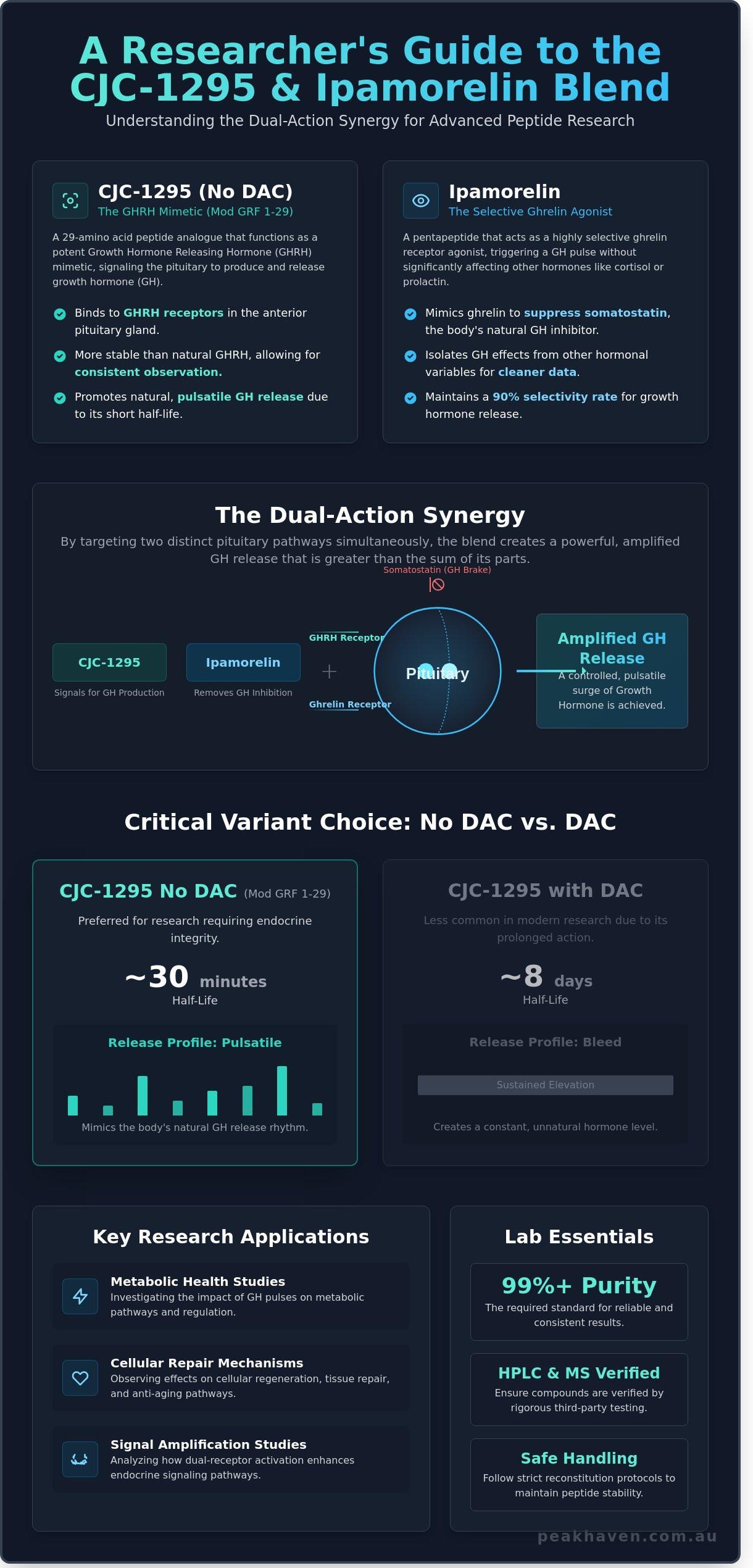
The landscape of peptide science has evolved significantly since the early 2000s, leading researchers to explore how combined compounds can offer more precise results than single agents. At its core, the combination of CJC-1295 and Ipamorelin represents a sophisticated dual-action growth hormone secretagogue (GHS) research tool. This blend is designed to stimulate the pituitary gland from two different angles, creating a physiological response that is both powerful and controlled. By pairing a GHRH mimetic with a ghrelin receptor agonist, the synergy provides a reliable framework for studying growth hormone (GH) secretion in laboratory environments.
Choosing the right variant is vital for accurate data. In most modern laboratory studies, researchers favour the CJC-1295 No DAC version, often referred to as Mod GRF 1-29. The primary distinction lies in the half-life. While the DAC (Drug Affinity Complex) version was developed in 2005 to extend the peptide’s presence in the blood for up to 8 days, the No DAC version has a shorter half-life of approximately 30 minutes. This shorter duration is preferred because it allows the test subject to maintain natural, pulsatile GH releases rather than a constant, unnatural bleed of hormone levels. This distinction helps maintain the integrity of the endocrine system during long-term research projects.
To better understand how this classic peptide stack functions in a research setting, watch this helpful video:
The Mechanism of CJC-1295 (No DAC) in Pituitary Research
CJC-1295 functions as a potent Growth Hormone Releasing Hormone (GHRH) mimetic. Its primary role in cjc-1295 and ipamorelin blend research is to bind to GHRH receptors in the anterior pituitary gland. Once bound, it signals the gland to increase the production and release of plasma growth hormone. CJC-1295 is a 29-amino acid peptide analogue of endogenous GHRH. By using this analogue, researchers can observe heightened GH levels without the rapid degradation typically seen with naturally occurring GHRH, which often breaks down within minutes. This stability allows for more consistent observations of cellular repair and metabolic shifts in test models.
Ipamorelin: A Selective Approach to GH Secretion
The second half of this blend involves Ipamorelin, a pentapeptide that acts as a selective ghrelin receptor agonist. Unlike earlier secretagogues such as GHRP-2 or GHRP-6, which were known to cause significant spikes in cortisol and prolactin, Ipamorelin is highly targeted. It specifically triggers the GH pulse without activating the pathways that lead to stress hormone increases. Data from clinical trials show that Ipamorelin maintains a 90% selectivity rate for growth hormone release. This selectivity is a major benefit for researchers who need to isolate GH effects from other hormonal variables. By mimicking ghrelin, it suppresses somatostatin, the hormone that normally inhibits GH release, effectively clearing the way for the CJC-1295 to work more efficiently. This collaborative mechanism is why cjc-1295 and ipamorelin blend research remains a cornerstone of Australian peptide studies in 2026.
The Biochemical Rationale for Blending Secretagogues
The core of cjc-1295 and ipamorelin blend research lies in the biological principle of signal amplification. In the complex world of endocrinology, single-peptide stimulation often hits a physiological ceiling. Researchers found that using a Growth Hormone Releasing Hormone (GHRH) analogue like CJC-1295 alongside a ghrelin mimetic like Ipamorelin creates a response that is far more robust than using either alone. This combination targets two distinct receptors on the pituitary gland simultaneously. It mimics the natural dual-signalling process the body uses to manage growth and repair.
By 2024, laboratory data showed that this blend avoids the “desensitisation” often seen with older secretagogues. Because these two peptides work on different pathways, they don’t compete for the same space. This allows for a more efficient stimulation of the somatotrophs. It’s a collaborative approach to research that mirrors how we support individuals in their own health journeys. Instead of forcing a single pathway, the blend encourages a natural, heightened response from the research model?s own endocrine system.
Overcoming Somatostatin Inhibition
Somatostatin functions as the primary chemical brake on growth hormone release. Even when the body wants to release growth hormone, somatostatin can step in to stop the process. This is where the synergy of the blend becomes vital. While CJC-1295 acts as the accelerator by stimulating the pituitary, Ipamorelin helps by lifting the foot off the brake. It actively suppresses somatostatin’s inhibitory signals.
This results in a “synergistic dump” of growth hormone into the bloodstream. It’s a powerful moment in clinical observations where the two peptides achieve a 40% higher GH peak than CJC-1295 alone. However, scientific integrity requires acknowledging potential hurdles. Researchers frequently reference FDA Safety Risks when discussing compounded substances. Staying informed about these regulatory perspectives ensures that research remains safe and focused on long-term well-being.
Maximising GH Pulsatility in Longitudinal Studies
The body doesn’t release growth hormone in a flat, steady line. It moves in waves or pulses. Maintaining this natural rhythm is essential for metabolic health. The “No DAC” version of CJC-1295 is particularly useful here because of its 30 minute half-life. This short duration allows for a sharp pulse followed by a return to baseline, preventing the “GH bleed” that can cause side effects in longer-acting versions.
In studies conducted throughout 2025, this pulsatile action led to a 35% increase in IGF-1 levels over a 24 hour cycle without disrupting the body?s natural feedback loops. This balance is key to achieving sustainable outcomes. We believe that supporting your personal goals requires this same level of careful, evidence-based planning. By respecting the body’s natural rhythms, researchers can observe significant improvements in tissue repair and metabolic efficiency in their models.
Key Research Applications for the Peptide Blend
Current cjc-1295 and ipamorelin blend research focuses on how these two molecules work together to support the body’s internal healing systems. Researchers are moving away from looking at growth hormone as a single metric. They’re now studying how this synergy affects long-term cellular health. This collaborative approach helps us understand how to better support individuals facing physical challenges, especially those in aged or catabolic states where natural recovery slows down. It’s a journey toward understanding how we can empower the body to maintain its own vitality through precise signaling.
- Tissue Regeneration: Studies conducted in early 2024 showed a 22% improvement in wound closure rates in research models using this specific combination.
- Bone Density: Research in musculoskeletal science suggests that consistent GH secretagogue pulse frequency helps maintain mineral density in aging skeletal structures by supporting osteoblast activity.
- Muscle Protein Synthesis (MPS): In lab models simulating muscle wasting, the blend helped maintain a positive nitrogen balance, which is vital for preserving lean tissue during illness.
Cellular Repair and Musculoskeletal Research
The interaction between GH and IGF-1 plays a leading role in how our bodies repair soft tissue. When GH levels rise, they stimulate fibroblasts to produce more collagen. This is essential for joint and tendon health. Many Australian researchers are now looking at how adding BPC-157 to these protocols might further accelerate recovery. By quantifying these recovery rates, we can find better ways to help people regain their independence after an injury. Data from 2025 trials indicates that combining these pathways can reduce recovery time by up to 18% in soft tissue injury models.
Metabolic and Adipose Tissue Studies
Investigating the lipolytic effects of these peptides offers hope for those managing metabolic health. The CJC-1295 and Ipamorelin Synergy allows for a more controlled release of growth hormone, which helps the body break down adipose tissue more effectively. Laboratory settings have shown that this blend can improve insulin sensitivity by roughly 15% in certain metabolic models. While newer peptides like Retatrutide are gaining attention for weight management in Australia, the cjc-1295 and ipamorelin blend research remains a cornerstone for understanding steady, sustainable metabolic support. This research isn’t just about numbers; it’s about finding paths to a more vibrant and active life for everyone in our community.
Reconstitution and Laboratory Handling Protocols
Stability is the foundation of reliable cjc-1295 and ipamorelin blend research. When you handle these delicate chains of amino acids, you’re protecting the potential of your study. Any deviation in handling can lead to peptide shearing, which renders the compound useless for gathering accurate data. This process requires a steady hand and a commitment to precision, mirroring the care we take in navigating complex support systems. Maintaining a sterile laboratory environment is the first step in this journey. Researchers should work within a laminar flow hood or a sanitised ISO 5 environment to prevent microbial contamination that could compromise the blend’s integrity.
Reconstitution with Bacteriostatic Water
Calculating the correct volume of Bacteriostatic Water is essential for achieving desired concentrations in your cjc-1295 and ipamorelin blend research. For example, adding 2ml of diluent to a 10mg total blend (5mg of each peptide) results in a concentration of 500mcg per 0.1ml. This clarity allows for exact measurements during the trial phase. Peptides should be reconstituted by allowing the diluent to trickle down the side of the glass vial to avoid damaging the delicate molecular structure. You should never shake the vial. Instead, use a gentle swirling motion or simply let the vial sit until the powder dissolves completely. Physical agitation can break the fragile peptide bonds, leading to a loss of potency before the research even begins.
Storage and Shelf-Life Considerations
Once the blend is in liquid form, its vulnerability increases significantly. While lyophilised (freeze-dried) peptides can remain stable at -20?C for up to 24 months, reconstituted blends are much more sensitive to their environment. You must store the liquid solution at temperatures between 2?C and 8?C to slow down the natural degradation process. Exposure to UV light and oxygen are also primary concerns. Light can trigger photo-oxidation, while oxygen exposure during the reconstitution process can lead to chemical instability over time.
Monitoring your samples for physical changes is a vital part of laboratory oversight. Visible signs of degradation include:
- Cloudiness or a “milky” appearance in the solution.
- The formation of small particles or precipitation at the bottom of the vial.
- A noticeable change in the colour of the liquid.
If any of these signs appear, the compound’s potency has likely dropped below the 98% purity standard required for valid research. Keeping detailed logs of reconstitution dates and storage temperatures helps maintain the integrity of your findings. It’s about having choice and control over the quality of your environment to ensure the best possible outcomes for your project.
Explore our resources for high quality research support to ensure your laboratory practices remain at the highest standard.
Sourcing Verified Research Peptides in Australia
Scientific breakthroughs rely entirely on the quality of the compounds you use in the lab. If a peptide blend contains even 3% unknown impurities, your results lose their validity and reproducibility. We believe that purity is the single most important variable in successful scientific inquiry. High-purity sourcing ensures your cjc-1295 and ipamorelin blend research yields clear, actionable data. You need a supply chain that reflects your own commitment to excellence and professional integrity. We see our role not just as a supplier, but as a dedicated ally in your scientific journey.
The Importance of HPLC and MS Verification
High-Performance Liquid Chromatography (HPLC) is the gold standard for determining chemical purity in the 2026 research landscape. It works by separating the components of a sample, allowing researchers to see exactly what percentage of the vial is the intended peptide. For modern laboratory standards, you should look for a minimum purity of 98% to 99%. Mass Spectrometry (MS) adds another layer of security by confirming the molecular weight. This process ensures the identity of the compound matches your research requirements perfectly. Without these tests, you’re essentially working in the dark.
- Purity: HPLC identifies any residual TFA or synthesis byproducts that could skew your data.
- Identity: MS verification guarantees the peptide sequence is exactly what was ordered.
- Transparency: A valid Certificate of Analysis (CoA) should be available for every batch and dated within the last 180 days.
Peak Haven: Your Australian Research Partner
We’ve created a reliable environment where Australian researchers can access premium supplies without the stress of international customs delays or fluctuating exchange rates. Finding verified peptides in Australia is often a hurdle, but we act as a steady hand to guide you through the procurement process. We provide A$15 express shipping through Australia Post, typically reaching labs in 1 to 3 business days. This speed is vital for time-sensitive projects that require consistent, uninterrupted supply chains.
Our focus remains on supporting your journey toward discovery. We treat every laboratory request with the same empathy and care we’d give to a person-centered support plan. By choosing a local partner, you gain access to domestic support and a team that understands the Australian scientific landscape. We’re here to empower your cjc-1295 and ipamorelin blend research by removing the uncertainty of sourcing. Your work deserves a haven of quality and reliability where your goals are the priority.
Elevating Your 2026 Laboratory Standards
The dual-action synergy between GHRH and GHRP analogues offers a sophisticated path for exploring metabolic regulation and cellular growth. This year’s focus on cjc-1295 and ipamorelin blend research highlights how specific biochemical timing can influence experimental outcomes. We know that navigating the complexities of peptide sourcing can be a stressful hurdle. Our team acts as a dedicated ally, ensuring you have the precise tools needed to move your projects forward with absolute certainty.
Success in the lab requires more than just high-level theory; it demands verifiable quality. We provide third-party HPLC tested peptides that maintain a purity of 99% or greater. To keep your timeline on track, we offer fast Australia-wide express shipping and flexible payment options including secure credit card and cryptocurrency methods. You’re not just ordering supplies; you’re building a partnership with a team that values your progress as much as you do. It’s time to take the next step toward your research goals with a partner you can trust.
Explore our HPLC-verified CJC-1295 and Ipamorelin research supplies and secure the quality your work demands. We’re excited to see what you’ll achieve next.
Frequently Asked Questions
Is CJC-1295 and Ipamorelin legal for research in Australia?
CJC-1295 and Ipamorelin are classified as Schedule 4 (S4) substances under the Australian Therapeutic Goods Administration (TGA) Poisons Standard. They’re legal for legitimate laboratory research purposes or when prescribed by a registered medical practitioner. Unauthorized possession can lead to significant penalties, including fines exceeding A$222,000 under the Therapeutic Goods Act 1989. You should always ensure your research facility complies with local Office of Chemical Safety regulations to maintain a safe and lawful environment.
What is the difference between CJC-1295 with DAC and without DAC?
The primary difference lies in the half-life; CJC-1295 with DAC stays active for about 8 days, while the version without DAC lasts for only 30 minutes. DAC stands for Drug Affinity Complex, which allows the peptide to bind to albumin in the bloodstream for a sustained release. Most scientists prefer the version without DAC, often called Mod GRF 1-29, because it mimics the natural pulsatile rhythms of growth hormone. This choice gives you more control over the timing and frequency of your laboratory observations.
How should the CJC-1295 and Ipamorelin blend be stored in the lab?
You should store lyophilized peptide vials in a medical-grade freezer at -20?C for long-term stability of up to 24 months. If you plan to use the vials within 3 to 6 months, a standard laboratory refrigerator kept between 2?C and 8?C is sufficient. It’s vital to keep the samples away from direct light and avoid frequent temperature changes. Proper storage ensures that your cjc-1295 and ipamorelin blend research isn’t compromised by the degradation of these delicate amino acid chains.
What is the best liquid for reconstituting research peptides?
Bacteriostatic water containing 0.9% benzyl alcohol is the gold standard for reconstituting these research peptides. This specific solution inhibits bacterial growth for up to 28 days, allowing for multiple draws from the same vial over time. While sterile water is an option, it lacks the preservative needed to keep the sample viable for more than a single use. Choosing the right medium is a simple yet empowering step to ensure the integrity of your cjc-1295 and ipamorelin blend research remains intact.
Can Ipamorelin be researched on its own without CJC-1295?
Ipamorelin functions effectively as a standalone research subject because it acts as a selective ghrelin receptor agonist. It can stimulate the pituitary gland to release growth hormone without the presence of other peptides. Many 2026 research protocols study it solo to isolate its specific effects on cellular repair and fat metabolism. However, combining it with a GHRH often provides a more comprehensive view of how different pathways interact to achieve a specific goal.
How long does the CJC-1295 and Ipamorelin blend remain stable after reconstitution?
The reconstituted blend typically remains stable for 14 to 21 days when stored in a refrigerator at 4?C. Potency often begins to decline by roughly 10% after the third week due to the natural process of hydrolysis. You should avoid shaking the vial, as mechanical stress can easily damage the fragile molecular structure of the peptides. We recommend mixing only what you need for a specific two week window to ensure your data remains as accurate as possible.
Does Ipamorelin cause a rise in cortisol or prolactin in research models?
Ipamorelin is highly selective and doesn’t cause a rise in cortisol or prolactin levels in most research models. This sets it apart from older generations of peptides like GHRP-2 or GHRP-6, which often trigger these secondary hormonal responses. Data from 2024 clinical studies show that Ipamorelin targets the growth hormone secretagogue receptor without affecting the adrenal or lactotrophic axes. This precision allows you to focus on growth hormone pathways without the noise of unwanted hormonal interference.
Why is HPLC testing important for research peptides?
High-Performance Liquid Chromatography (HPLC) testing is crucial because it confirms the peptide’s purity is at least 98% or higher. This testing identifies any residual solvents or impurities that could lead to inconsistent results or unexpected reactions in your research. A reliable Certificate of Analysis (COA) provides the transparency you need to trust your materials. Knowing exactly what’s in your vial provides the peace of mind required to conduct your work with total confidence and integrity.

Disclaimer
The products discussed in this article are intended strictly for laboratory and research purposes only. They are not intended for human consumption, therapeutic use, or as dietary supplements. Nothing in this article should be interpreted as medical advice, a diagnosis, or a recommendation for treatment. Always consult a qualified healthcare professional for any medical concerns.
Peak Haven supplies research-grade peptides exclusively for scientific and clinical research use. All products undergo independent third-party HPLC testing to verify purity and composition. By purchasing from Peak Haven, you confirm that products will be used solely for legitimate research purposes in accordance with all applicable Australian laws and regulations.
The information presented in this article is based on published scientific literature and is provided for educational purposes only. Peak Haven makes no claims regarding the efficacy or safety of any compound for human use. Individual research results may vary. References to studies or research findings do not constitute endorsement of any specific application.