
Troubleshooting Inconsistent Peptide Experiment Results: A Laboratory Guide
By Peak Haven12 min read
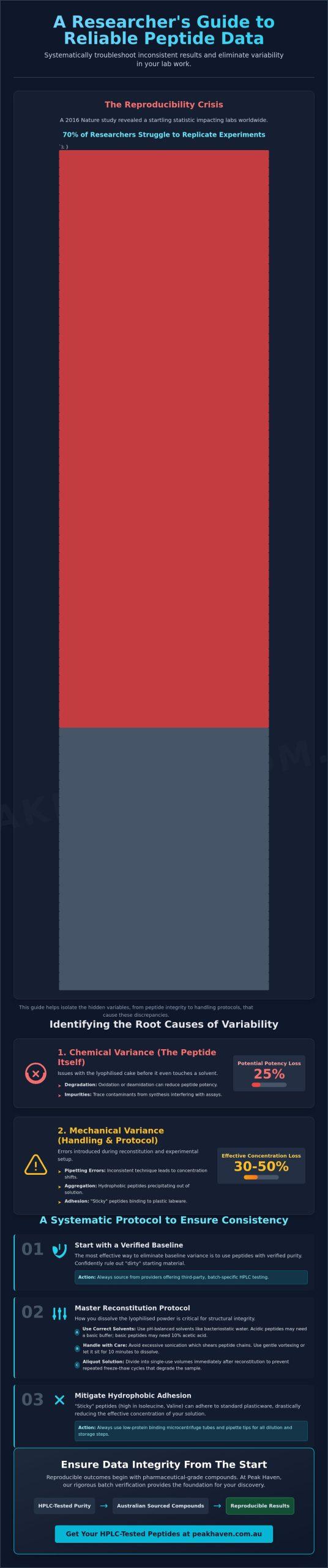
What if the 70% of researchers who struggle to replicate experimental data, as reported in a 2016 study by Nature, are simply missing one hidden variable in their benchwork? We understand the sinking feeling that comes with troubleshooting inconsistent peptide experiment results after investing weeks of your budget and energy into a study. It’s often difficult to pinpoint whether a lack of solubility or rapid degradation stems from the peptide sequence itself or a minor deviation in your handling protocols.
You deserve a clear path to reliable data that stands up to the rigours of peer review or clinical phase planning. This guide empowers you to master the technical variables and protocols required to eliminate variability in your research. We’ll walk through a systematic checklist to isolate variables and provide the standardised reconstitution protocols we use at Peak Haven. By focusing on pharmaceutical grade peptides and our rigorous HPLC tested peptides Australia standards, you can transform your laboratory outcomes into a consistent journey toward discovery.
Key Takeaways
- Learn how to differentiate between chemical degradation in the lyophilised cake and liquid phase errors to pinpoint the exact source of variability in your data.
- Master the technical variables of troubleshooting inconsistent peptide experiment results by auditing your reconstitution protocols and solvent purity standards.
- Discover the critical role of pH-balanced solvents and sequence-specific reconstitution guidelines in maintaining the structural integrity of your research compounds.
- Understand why sourcing from reputable Australian providers with third-party HPLC testing is the most effective way to eliminate baseline variance.
- Explore how rigorous batch verification for compounds like Retatrutide 20mg supports data integrity and ensures reproducible outcomes in complex assays.
Identifying the Root Causes of Peptide Variability
In the demanding environment of an Australian research lab, troubleshooting inconsistent peptide experiment results often begins by defining the exact nature of the variance. Experimental inconsistency in protein-binding or inhibition assays typically manifests as high standard deviations between technical replicates or a lack of reproducibility between different batches. These discrepancies usually stem from two distinct areas: the chemical integrity of the lyophilised cake or errors introduced once the peptide enters the liquid phase. Understanding the nuances of peptide synthesis methods is vital, as the chemical process itself can leave behind trace impurities that interfere with sensitive biological assays.
To better understand this concept, watch this helpful video:
Chemical vs. Mechanical Variance
Mechanical variance is frequently the culprit behind inaccurate technical repeats. Inconsistent pipetting techniques, especially when handling small microlitre volumes or viscous solvents like DMSO, can lead to significant concentration shifts across a 96-well plate. Beyond human error, the chemical stability of the primary sequence is a major factor. Oxidation of methionine residues or the deamidation of asparagine can reduce peptide potency by as much as 25% over a short period if storage conditions fluctuate.
At Peak Haven, we provide third-party HPLC-verified purity data for every batch, including research materials like MOTS-c 10mg. This rigorous testing serves as your baseline. By confirming that your starting material is pharmaceutical grade, you can confidently rule out “dirty” peptides and focus your troubleshooting on bench-side protocols. Our Australian-based shipping ensures these delicate compounds spend less time in transit, preserving their structural integrity for your studies.
The Impact of Sequence Hydrophobicity
Sequence-specific traits, particularly hydrophobicity, contribute heavily to assay noise. Hydrophobic residues such as Isoleucine, Valine, and Phenylalanine often lead to spontaneous aggregation and precipitation once the peptide is reconstituted. These “sticky” peptides have a high affinity for standard plastic labware, adhering to the walls of microcentrifuge tubes and pipette tips. This phenomenon can reduce the effective concentration of your solution by 30% to 50% before the sample even reaches the assay plate.
To mitigate this concentration loss, we recommend using low-protein binding tubes for all dilution steps. When working with sequences like GHK-Cu 100mg, ensuring the peptide is fully dissolved in a high-quality solvent like bacteriostatic water is essential. Proper solubilisation prevents the formation of microscopic aggregates that can lead to “hot spots” in your data, ensuring your research remains both reliable and reproducible.
Standardising Reconstitution and Buffer Protocols
Precision in the lab starts with how you handle your lyophilised powder. When you are troubleshooting inconsistent peptide experiment results, the problem often lies in the initial interaction between the powder and the solvent. Using pH-balanced bacteriostatic water is essential for maintaining the primary structure of your research compounds. This solvent contains 0.9% benzyl alcohol, which inhibits microbial growth and preserves the integrity of the peptide chain during multi-day studies. You’ll need to choose your primary solvent based on the sequence’s net charge. Acidic peptides usually require a small amount of basic buffer, while basic peptides dissolve more readily in 10% acetic acid.
Limit sonication to only the most stubborn samples. Excessive mechanical energy causes shearing of delicate amino acid chains, leading to degraded samples and skewed results. Instead, use gentle vortexing or allow the vial to sit at room temperature for 10 minutes. Once dissolved, follow the ‘aliquoting’ rule. Divide your solution into single-use volumes to prevent repeated freeze-thaw cycles. Each cycle can reduce peptide potency by up to 20% due to ice crystal formation and molecular stress.
Solubility Optimisation Strategies
For unknown or complex sequences, we recommend the ‘Rule of Three’. Start with sterile water, then move to 10% acetic acid for basic peptides, and finally 0.1% ammonium hydroxide for acidic ones. Hydrophobic compounds often require a small volume of DMSO for initial dissolution. Keep the final DMSO concentration below 5% in your working buffer to avoid cellular toxicity. For detailed handling procedures, consult our resources on correct reconstitution techniques.
Buffer Compatibility and Background Signal
Standard buffers like Phosphate Buffered Saline (PBS) are laboratory staples, but they can cause immediate precipitation in specific peptide blends. This is common in sequences containing several hydrophobic residues. If you notice cloudiness, try adding 0.01% Tween 20 or 0.1% BSA to reduce non-specific binding to plastic tube walls. The Z-factor is a dimensionless coefficient that measures assay quality by comparing the separation between signal and background against the standard deviation of the results. Ensuring a Z-factor above 0.5 is a critical step in troubleshooting inconsistent peptide experiment results to confirm your assay is robust enough for reliable data collection.
If you’re looking to refine your laboratory setup, you can find high-purity peptide blends for research at Peak Haven, where every batch undergoes rigorous HPLC testing.
Step-by-Step Troubleshooting for Inconsistent Assays
Finding variance in your data can feel like a setback, but it’s a common hurdle when troubleshooting inconsistent peptide experiment results. Achieving reproducibility requires a methodical look at every variable in your laboratory workflow. Follow these five steps to identify where the deviation occurs.
- Step 1: Verify Purity. Always start by reviewing the HPLC and MS reports for your specific batch. Peak Haven provides third-party testing to ensure purity levels meet or exceed 98%. If your starting material lacks this documentation, the impurities could be causing non-specific binding or unexpected cellular responses.
- Step 2: Audit Reconstitution. Review your protocol for solvent purity and temperature. Using bacteriostatic water or sterile saline that hasn’t been properly equilibrated to room temperature can cause peptide aggregation.
- Step 3: Perform a Serial Dilution Test. Run a 10-point serial dilution to find the “sweet spot” of biological activity. This helps identify if you’re dealing with a hook effect or if the peptide concentration is simply too high, leading to toxicity rather than the intended research outcome.
- Step 4: Review Storage Conditions. Inspect your freezer logs for fluctuations. Peptides are sensitive to freeze-thaw cycles. Ensure your -20?C or -80?C environment hasn’t experienced power dips or door-open alerts, as even a 5-degree shift can degrade sensitive sequences.
- Step 5: Use a Positive Control. Cross-reference your current results with a reliable standard like GHK-Cu. If the control performs as expected but your test peptide doesn’t, the issue likely lies with the specific peptide’s stability or the assay’s sensitivity to that sequence.
Isolating the Solvent Variable
DMSO is a standard solvent, yet it can be a silent saboteur in research. Some enzymes are inhibited by DMSO concentrations as low as 0.1%. To test this, run a “vehicle-only” control alongside your experiment. When diluting stock solutions, add the buffer to the peptide slowly to prevent immediate precipitation. Ensure all technical repeats originate from a single premix rather than being pipetted individually from the stock to maintain absolute uniformity across your plate.
Mechanical Calibration and Technical Repeats
Precision in micro-volume peptide research relies entirely on your equipment. Pipettes should be calibrated every six months to meet ISO 8655 standards. To verify your technique, calculate the Coefficient of Variation (CV) between technical replicates by dividing the standard deviation by the mean. A CV exceeding 10% indicates mechanical or procedural error. This often suggests that air bubbles or tip-wetting inconsistencies are skewing your data points.
Reliable research starts with high-purity compounds you can trust. Shop high-purity research peptides at Peak Haven to ensure your laboratory foundations are solid.
Ensuring Data Integrity with HPLC-Tested Research Peptides
Success in the laboratory begins long before the first pipette is drawn. When you’re troubleshooting inconsistent peptide experiment results, the purity of your starting material is often the hidden variable that derails a study. Sourcing from reputable peptide labs is your primary defence against experimental variance. If a compound contains even 2% to 4% unknown impurities, your data can shift in ways that are impossible to replicate or explain. We provide the stability you need to focus on your findings, not your supplies.
The Peak Haven Quality Standard
We treat every batch with the same level of scrutiny you apply to your research. Every compound, including specialized options like the BPC-157 + TB-500 stack, undergoes rigorous third-party HPLC and Mass Spectrometry verification. This process ensures that what’s on the label is exactly what’s in the vial. By providing peptides in a stable, lyophilised state, we help you maintain long-term study integrity. Lyophilisation removes moisture that causes degradation, allowing for consistent results over months of observation. This level of transparency builds the trust necessary for high-stakes scientific inquiry.
Securing Your Research Supply Chain
International shipping is a common source of troubleshooting inconsistent peptide experiment results for Australian researchers. Heat is the enemy of peptide stability. A vial sitting in a customs warehouse for 10 or 14 days can lose significant biological activity before it even reaches your bench. We solve this through Australian-based express shipping. By minimizing the ‘last mile’ distance, we prevent thermal degradation during the peak of the Australian summer. This reliability is vital for time-sensitive projects involving high-purity compounds like Retatrutide 20mg. Our logistics are designed to protect your investment and your time.
All compounds provided by Peak Haven are strictly for laboratory research applications. Using high-purity research compounds ensures that your cellular models and assays remain untainted by external contaminants. We’re here to be your partner in discovery, providing the tools you need to push the boundaries of science with confidence. Every interaction is a step toward more reliable and impactful research outcomes.
Empowering Your Path to Reproducible Research Results
Your journey toward precise, reproducible data depends on the synergy between meticulous laboratory technique and the quality of your raw materials. By standardising your reconstitution protocols and maintaining strict buffer consistency, you’ve already addressed the most common variables that lead to data drift. Success in the lab isn’t just about the steps you take; it’s about the absolute confidence you have in your compounds. Your choice of reagents determines the clarity of your experimental path.
When you’re troubleshooting inconsistent peptide experiment results, the purity of your sample is often the deciding factor. Eliminating contaminants through rigorous third-party HPLC verification ensures that your cellular assays remain untainted by unexpected variables. We understand that your research goals are ambitious. We’re here to provide the steady foundation you need to reach your highest potential in the laboratory. Our focus on integrity lets you focus entirely on your next discovery.
Explore our HPLC-tested research peptide range at Peak Haven. We support your work with fast Australia-wide express shipping to ensure your project timelines stay on track. We’re proud to be your dedicated ally in the pursuit of scientific excellence.
Frequently Asked Questions
Why is my peptide not dissolving completely in bacteriostatic water?
Solubility depends on the peptide’s unique isoelectric point and overall hydrophobicity. Acidic peptides with a net negative charge often require a small amount of dilute acetic acid to dissolve, while basic sequences might need dilute ammonium hydroxide. If you’re troubleshooting inconsistent peptide experiment results, start by calculating the sequence’s charge. Research from the 2019 Journal of Peptide Science indicates that 15% of synthetic sequences require specific pH adjustments to achieve full solubility in aqueous buffers.
Can I refreeze a peptide solution after it has been thawed once?
You shouldn’t refreeze peptide solutions because the freeze-thaw cycle creates ice crystals that physically shear the delicate peptide chains. This mechanical stress leads to aggregation or loss of biological activity in up to 30% of sensitive sequences. It’s much better to aliquot your solution into single-use vials immediately after your initial reconstitution. This practice ensures your research peptides Australia projects maintain high integrity and produce reliable, reproducible data across every laboratory trial.
How do I know if my peptide has degraded during shipping to Australia?
Visual inspection won’t reveal molecular degradation, so you’ll need to perform an analytical check like HPLC or Mass Spectrometry to be certain. Shipping to Australia involves long transit times, but Peak Haven uses temperature-controlled packaging to mitigate these risks. If a sample is exposed to temperatures above 37 degrees Celsius for more than 48 hours, purity can drop by 5% or more. Always check the third-party HPLC report provided with your order to verify starting purity levels.
What is the best way to store lyophilised peptides for long-term research?
Store your lyophilised powders in a freezer at -20 degrees Celsius or -80 degrees Celsius for maximum stability over 12 to 24 months. Ensure the vials are tightly sealed and kept in a desiccator to prevent moisture absorption, which triggers damaging hydrolysis. When you buy peptides Australia from Peak Haven, they arrive in vacuum-sealed vials designed for long-term storage. A 2021 stability study showed that properly stored peptides retain 98% of their bioactivity after one year at sub-zero temperatures.
Does the presence of DMSO in my assay affect the protein-peptide binding results?
Yes, DMSO concentrations above 1% can significantly alter protein conformation and interfere with your binding affinity measurements. While DMSO is a powerful solvent for hydrophobic sequences, it can compete with the peptide for binding sites or destabilise the protein target itself. Researchers often limit DMSO to 0.1% in final assay buffers to avoid these common artifacts. When you’re troubleshooting inconsistent peptide experiment results, always run a vehicle control to account for these solvent effects.
Is it necessary to use HPLC-tested peptides for in vitro studies?
Using HPLC tested peptides Australia is essential because even minor impurities can cause off-target effects or cell toxicity in your assays. A 5% impurity profile can lead to false positives or non-reproducible data in sensitive cell culture models. Peak Haven provides pharmaceutical grade peptides with a minimum of 98% purity to ensure your results remain scientifically sound. High-purity reagents are the cornerstone of reliable research and successful peer-reviewed publications. Explore our full range of high-purity sequences at peakhaven.com.au.

Disclaimer
The products discussed in this article are intended strictly for laboratory and research purposes only. They are not intended for human consumption, therapeutic use, or as dietary supplements. Nothing in this article should be interpreted as medical advice, a diagnosis, or a recommendation for treatment. Always consult a qualified healthcare professional for any medical concerns.
Peak Haven supplies research-grade peptides exclusively for scientific and clinical research use. All products undergo independent third-party HPLC testing to verify purity and composition. By purchasing from Peak Haven, you confirm that products will be used solely for legitimate research purposes in accordance with all applicable Australian laws and regulations.
The information presented in this article is based on published scientific literature and is provided for educational purposes only. Peak Haven makes no claims regarding the efficacy or safety of any compound for human use. Individual research results may vary. References to studies or research findings do not constitute endorsement of any specific application.