
Tirzepatide Mechanism of Action Study: Dual GIP and GLP-1 Agonism in Research
By Peak Haven12 min read

Could a single synthetic peptide actually achieve more through biased agonism than the body’s own natural hormones? You’ve likely noticed that since landmark clinical data emerged in 2022, the Australian research community has been captivated by the potential of dual-agonist compounds, yet finding precise data on receptor affinity often feels like a challenge. It’s frustrating when ambiguity around molecular pathways slows down your progress or leaves you questioning the stability of your samples during a critical project.
Our comprehensive tirzepatide mechanism of action study is designed to be your reliable guide, offering a deep dive into how this “twincretin” molecule interacts with both GIP and GLP-1 receptors at a cellular level. We’ll walk through the synergistic pathways that drive research outcomes, provide clear protocols for peptide reconstitution in your lab, and explain why our Australian-based, HPLC-tested peptides ensure your results remain consistent. By the end of this guide, you’ll have a standardized approach to handling these complex sequences, backed by the transparency and integrity of Peak Haven?s rigorous quality standards. We’re here to support your journey toward discovery with the precision your work deserves.
Key Takeaways
- Understand the structural evolution of dual GIP and GLP-1 agonism and how this synergy enhances metabolic research outcomes compared to traditional single-receptor peptides.
- Examine the cellular pathways highlighted in our tirzepatide mechanism of action study, specifically the activation of adenylate cyclase and the subsequent rise in intracellular cAMP.
- Learn precise laboratory protocols for reconstitution using bacteriostatic water to maintain optimal compound stability and research integrity.
- Identify the critical markers of quality when sourcing research peptides in Australia, including the importance of third-party HPLC verification and secure local shipping.
Tirzepatide Mechanism of Action: The Evolution of Dual Agonism
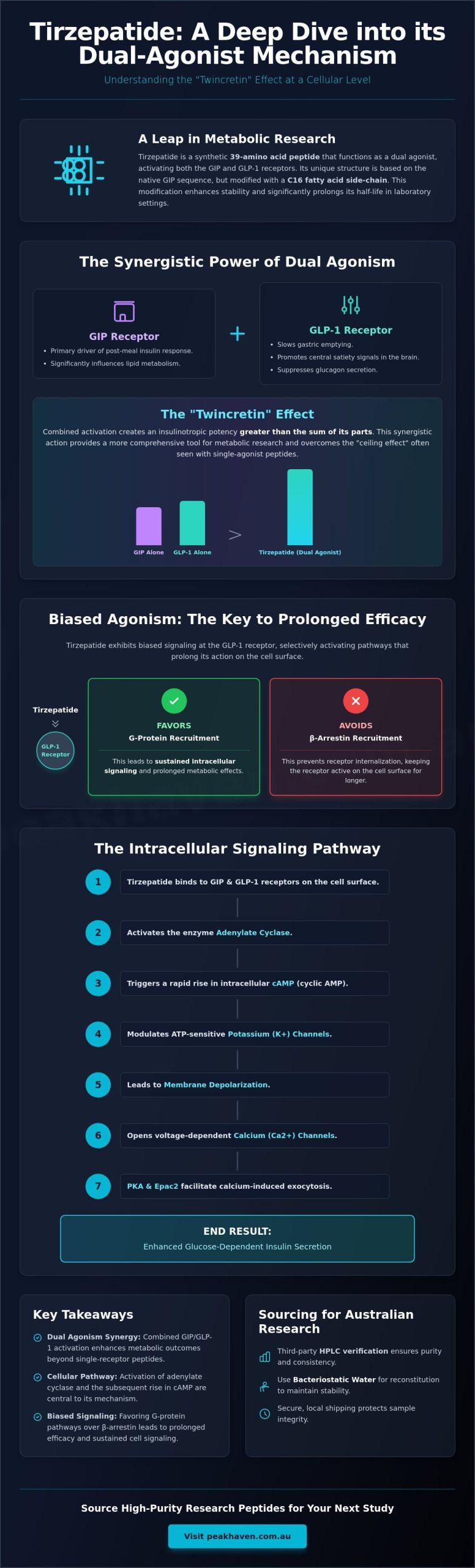
Tirzepatide represents a significant leap in metabolic research, functioning as a synthetic 39-amino acid peptide that targets two distinct pathways. As a dual agonist, it activates both the glucose-dependent insulinotropic polypeptide (GIP) and glucagon-like peptide-1 (GLP-1) receptors. This unique structural foundation is based on the native GIP sequence, integrated with a C16 fatty acid side-chain to enhance stability and prolong its half-life in laboratory environments. Understanding a tirzepatide mechanism of action study requires looking at how these two pathways collaborate to achieve results that monotherapies often cannot match.
In many research models, GLP-1 receptor agonists alone reach a “ceiling effect” where further dosing doesn’t improve metabolic outcomes or leads to increased sensitivity in the subject. Dual agonism addresses this limitation by recruiting the GIP receptor to complement GLP-1 activity. For Australian researchers, this establishes a new, high-performance baseline for obesity-related and metabolic laboratory studies. Peak Haven supports this scientific journey by providing HPLC-tested research peptides and supplies that allow for precise investigations into these complex interactions. Researchers looking to expand their focus may also find interest in retatrutide, which builds upon this dual-agonist foundation.
GIP vs. GLP-1: Distinct Roles in Metabolic Regulation
While both are incretin hormones, they play different roles in metabolic regulation. GIP acts as a primary driver of insulin secretion following a meal, while GLP-1 is frequently studied for its role in slowing gastric emptying and appetite suppression models. Research into Tirzepatide’s dual agonist behavior highlights the “twincretin” concept. This suggests that dual activation creates an insulinotropic potency that is greater than the sum of its parts, providing a more comprehensive tool for metabolic research.
- GIP Receptor: Influences lipid metabolism and postprandial insulin response.
- GLP-1 Receptor: Focuses on glucagon suppression and central satiety signals.
- Synergistic Effect: The combined activation enhances glucose-dependent insulin secretion more effectively than either agonist alone.
Biased Agonism at the GLP-1 Receptor
A fascinating aspect of tirzepatide is its biased signaling at the GLP-1 receptor. In laboratory assays, tirzepatide favors G-protein recruitment over the recruitment of ?-arrestin. This distinction is vital because ?-arrestin typically leads to receptor internalisation, which shuts down signaling. By avoiding this path, tirzepatide allows for sustained signaling on the cell surface. Biased agonism is the selective activation of specific intracellular pathways by a ligand. This mechanism is a core focus for anyone conducting a tirzepatide mechanism of action study, as it explains the peptide’s prolonged efficacy in cellular models compared to traditional agonists.
Molecular Signaling Pathways and Cellular Effects in Research
The dual agonism of tirzepatide triggers a complex cascade of intracellular events that distinguish it from traditional single-receptor agonists. When the peptide binds to the GIP and GLP-1 receptors, it activates the enzyme adenylate cyclase. This activation leads to a rapid rise in intracellular cyclic adenosine monophosphate (cAMP). In pancreatic beta-cell models, this increase in cAMP serves as a primary signal for metabolic regulation. This specific tirzepatide mechanism of action study focus reveals how the peptide modulates ATP-sensitive potassium (KATP) channels, leading to membrane depolarisation and the subsequent opening of voltage-dependent calcium channels.
The role of protein kinase A (PKA) and exchange protein directly activated by cAMP 2 (Epac2) is central to facilitating calcium-induced insulin exocytosis. These pathways work in tandem to enhance the efficiency of the secretory response in laboratory settings. According to a Clinical Overview of Tirzepatide, these molecular shifts provide a more robust response compared to mono-agonist compounds. Researchers often compare these effects to newer molecules like retatrutide, which introduces a third receptor agonism for glucagon, potentially expanding the scope of metabolic research.
Impact on Lipid Metabolism and Adipose Tissue
Research findings on GIP receptor activity in white adipose tissue (WAT) show that tirzepatide influences how lipids are processed at a cellular level. In animal models, the peptide appears to improve lipid buffering, which contributes to enhanced systemic insulin sensitivity. There is a unique synergy observed between GLP-1 induced lipolysis and GIP-mediated lipid storage regulation. This balance is a primary area of interest in any tirzepatide mechanism of action study, as it suggests a more sophisticated method of energy management than previously understood in peptide research.
Cardiorenal and Neuroprotective Research Applications
The presence of GLP-1 and GIP receptors in the central nervous system (CNS) has opened new doors for neuroprotective research. Scientists are exploring mechanisms that may protect neural pathways from degradation, offering a promising foundation for future neurodegenerative studies. In hypertensive research models, the peptide has shown an ability to influence renal biomarkers and blood pressure regulation. These multi-organ effects make tirzepatide a versatile tool for Australian researchers looking to understand the broader implications of dual-receptor activation. If you are looking to advance your laboratory’s capabilities, you can find high-purity research peptides Australia through our verified catalogue.
Laboratory Protocols: Reconstitution, Handling, and Storage
Success in a tirzepatide mechanism of action study depends on the integrity of the peptide. Maintaining a sterile environment is the first step. Researchers must use aseptic techniques to prevent microbial contamination, which can degrade the dual GIP/GLP-1 agonist and skew experimental data. We recommend working within a laminar flow hood and ensuring all contact surfaces are sanitised with 70% isopropyl alcohol before beginning the reconstitution process.
Proper reconstitution is vital for compound stability. Using bacteriostatic water is the standard for maintaining longevity in a laboratory setting. The 0.9% benzyl alcohol acts as a preservative, extending the viable window for multi-dose studies. When calculating concentrations, precision is key for micro-dosing. For instance, adding 2ml of diluent to a 5mg vial creates a concentration of 2.5mg/ml. This allows for accurate measurements during longitudinal observations without wasting valuable research material.
Mechanical stress is a common pitfall that can compromise your research. Peptides are fragile chains of amino acids. Shaking a vial can lead to denaturation, rendering the tirzepatide biologically inactive. Researchers should use a gentle swirling motion or allow the diluent to run down the side of the vial to dissolve the lyophilised powder naturally. Don’t rush this process; patience ensures the peptide’s primary structure remains intact for the duration of your study.
Optimising Stability and Longevity
Temperature control is critical in the Australian climate, where ambient heat can quickly degrade sensitive compounds. Lyophilised tirzepatide should be stored at -20?C for long-term stability. Once reconstituted, it requires refrigeration between 2?C and 8?C. Light sensitivity is another factor. UV exposure can break peptide bonds, so we suggest using amber vials or storing samples in complete darkness to preserve potency over a 30-day research cycle. These steps help maintain the structural integrity required for precise data collection.
The Critical Role of HPLC Testing
Reliability in any tirzepatide mechanism of action study requires verified purity. Third-party HPLC (High-Performance Liquid Chromatography) testing ensures the peptide matches its labelled sequence and concentration. At Peak Haven, we prioritise 99%+ purity. This level of refinement means fewer impurities that could interfere with receptor binding assays or cellular signaling pathways. Choosing HPLC tested peptides Australia ensures your results are reproducible and your data remains untainted. For broader context on the Australian research landscape, consulting the Peptides Australia guide helps researchers align with local laboratory standards.
Ensure your research is backed by purity and precision. Explore our range of laboratory-grade supplies at Peak Haven today.
Sourcing Tirzepatide for Australian Research Institutions
Securing high-quality materials for a tirzepatide mechanism of action study requires a rigorous vetting process of local suppliers. Australian researchers often encounter significant hurdles when sourcing compounds from overseas, such as unpredictable customs delays and temperature fluctuations that can compromise peptide integrity. Peak Haven addresses these challenges by maintaining a robust supply chain within Australia. Our commitment to excellence is backed by third-party HPLC verification, ensuring that every batch meets the 99% purity threshold required for precise laboratory data. By operating out of dedicated distribution hubs in Melbourne and Sydney, we provide national express shipping that keeps your research timeline on track.
Reliability in procurement is about more than just fast delivery; it’s about the security of knowing your laboratory supplies are consistent. We offer dedicated support for institutional procurement, handling bulk research orders with the professional care your project deserves. This local presence allows us to act as a steady hand in the complex world of peptide research, helping you maintain focus on your scientific objectives rather than logistics. For laboratories expanding their scope into synergistic effects, we offer the Total Transformation Stack to facilitate more complex metabolic interaction studies.
Navigating the Australian Research Landscape
Local sourcing is the most effective way to avoid the risks associated with international transit. When you buy research peptides Australia through Peak Haven, you eliminate the 14-day wait times typical of international shipping. All our products carry a strict “Research Use Only” designation, ensuring they’re utilized correctly within laboratory settings. We prioritize transparency and empower researchers by providing clear documentation for every compound. This structural clarity builds trust, allowing your team to exercise full control over your experimental variables without worrying about the quality of your base materials.
Future Directions in Multi-Receptor Agonist Research
The success of the tirzepatide mechanism of action study has opened the door to the next frontier: tri-agonists. While tirzepatide focuses on GLP-1 and GIP receptors, the evolving landscape of metabolic research is now exploring the addition of Glucagon receptor agonism. This triple-receptor approach represents a significant leap in understanding cellular signaling and energy homeostasis. Peak Haven is proud to be a partner in this journey, providing the pharmaceutical grade peptides needed to explore these new horizons. We view our role not just as a supplier, but as a bridge between your laboratory’s needs and the high-purity resources required to achieve your highest potential in scientific discovery.
Explore the full range of research peptides at Peak Haven and find the reliable compounds your institution needs for its next breakthrough.
Empowering Scientific Discovery Through Dual Agonism
The tirzepatide mechanism of action study underscores how the synergistic activation of GIP and GLP-1 receptors creates a more robust cellular response than traditional single-receptor agonists. Researchers now have a clearer understanding of how these specific molecular pathways influence metabolic markers in controlled laboratory environments. Achieving reproducible results depends heavily on the integrity of your materials and the precision of your storage protocols. Peak Haven supports the Australian scientific community by providing the essential tools needed for these complex investigations. You’ll find third-party HPLC tested peptides with 99%+ purity to ensure your data remains consistent and verifiable. We prioritize your project’s timeline with fast Australia-wide express shipping and offer secure payment options, including credit cards and cryptocurrency. Our team is here to act as your reliable partner in scientific discovery, helping you navigate the requirements of high-level research with confidence.
Order HPLC-Tested Tirzepatide for Your Research at Peak Haven
We’re excited to support your journey toward the next great scientific breakthrough.
Frequently Asked Questions
What is the primary mechanism of action for tirzepatide in research models?
How should tirzepatide be reconstituted for laboratory use?
Researchers should reconstitute tirzepatide using bacteriostatic water or sterile saline, depending on the specific protocol requirements. For a standard 5mg vial, adding 1ml of diluent creates a concentration of 5mg/ml. It’s vital to gently swirl the vial rather than shaking it to preserve the delicate peptide structure. When you buy tirzepatide Australia from Peak Haven, we ensure the lyophilised powder arrives in a stable state, ready for precise measurement in your laboratory environment.
Is tirzepatide more effective than semaglutide in weight regulation studies?
In the SURMOUNT-1 clinical trial data from 2022, tirzepatide demonstrated a 20.9% body weight reduction in subjects compared to 14.9% for semaglutide over a 72-week period. Research models often show that the addition of GIP receptor agonism provides a superior metabolic response compared to GLP-1 agonism alone. These comparative studies help scientists understand the potent synergy of dual-receptor activation. You can find high-purity options for these comparative trials within our research peptides Australia range.
What are the storage requirements for research-grade tirzepatide?
Store lyophilised tirzepatide in a freezer at -20?C for long-term stability of up to 24 months. Once you’ve reconstituted the peptide, keep the solution refrigerated between 2?C and 8?C and use it within 28 days to prevent degradation. Exposure to light and heat can compromise the peptide’s integrity. Peak Haven provides temperature-controlled Australian-based shipping to ensure your pharmaceutical grade peptides arrive with their molecular structure fully intact for your experiments.
Why is HPLC testing important for tirzepatide peptides?
HPLC testing is essential because it verifies the chemical purity and correct molecular weight of the peptide batch. At Peak Haven, we provide third-party HPLC tested peptides Australia to guarantee a purity level of 99% or higher. This level of transparency ensures that your research isn’t skewed by contaminants or incorrect concentrations. Without verified testing, researchers risk inconsistent data and wasted resources during a tirzepatide mechanism of action study.
Can tirzepatide be used in studies involving non-diabetic metabolic models?
Researchers frequently use tirzepatide in non-diabetic models to study its effects on obesity, non-alcoholic fatty liver disease, and cardiovascular health. A 2023 study highlighted its ability to improve insulin sensitivity and reduce hepatic fat content in subjects without type 2 diabetes. These applications allow for a broader understanding of how dual agonism influences systemic metabolic health. Explore our full range of peptide stacks for research at peakhaven.com.au to support your next metabolic study.

Article by
Peak Haven Research Team
Peak Haven is Australia’s leading supplier of high-purity research peptides, verified through independent third-party HPLC testing. Based in Australia with fast nationwide shipping.
Disclaimer
The products discussed in this article are intended strictly for laboratory and research purposes only. They are not intended for human consumption, therapeutic use, or as dietary supplements. Nothing in this article should be interpreted as medical advice, a diagnosis, or a recommendation for treatment. Always consult a qualified healthcare professional for any medical concerns.
Peak Haven supplies research-grade peptides exclusively for scientific and clinical research use. All products undergo independent third-party HPLC testing to verify purity and composition. By purchasing from Peak Haven, you confirm that products will be used solely for legitimate research purposes in accordance with all applicable Australian laws and regulations.
The information presented in this article is based on published scientific literature and is provided for educational purposes only. Peak Haven makes no claims regarding the efficacy or safety of any compound for human use. Individual research results may vary. References to studies or research findings do not constitute endorsement of any specific application.