
If BPC-157 is celebrated globally for its regenerative potential, why does the question of its legality in your own lab feel so complicated? You’re likely caught between the excitement of scientific discovery and the stress of conflicting reports about sports bans and medical restrictions. It’s a common challenge to ask, is bpc 157 legal in australia, especially when you’re trying to stay compliant while pushing the boundaries of your research. You deserve a clear path forward that respects your professional goals and your peace of mind.
We’ve created this definitive 2026 guide to help you move through the TGA Schedule 4 landscape with confidence. You’ll gain a thorough understanding of the distinction between clinical applications and research compliance, ensuring your projects meet every regulatory standard. We’ll also explore the specific documentation requirements for international sourcing and introduce you to reliable Australian partners for high-purity compounds. Together, we can turn this complex regulatory journey into a collaborative step toward your next breakthrough.
Key Takeaways
- Understand why the question is bpc 157 legal in australia depends on its Schedule 4 classification and how you can maintain full compliance for your research projects.
- Learn to navigate the critical boundary between human consumption and scientific research by mastering the labeling requirements set by Australian regulatory bodies.
- Discover why sourcing your research peptides from domestic Australian suppliers offers greater security and speed compared to the risks of international customs.
- Access a practical compliance checklist designed to help your facility verify its biosafety levels and ensure every unit is handled with professional integrity.
- Explore how partnering with a dedicated ally like Peak Haven can empower your research journey through high-purity compounds and discreet, express national shipping.
The Current Legal Status of BPC-157 in Australia for 2026
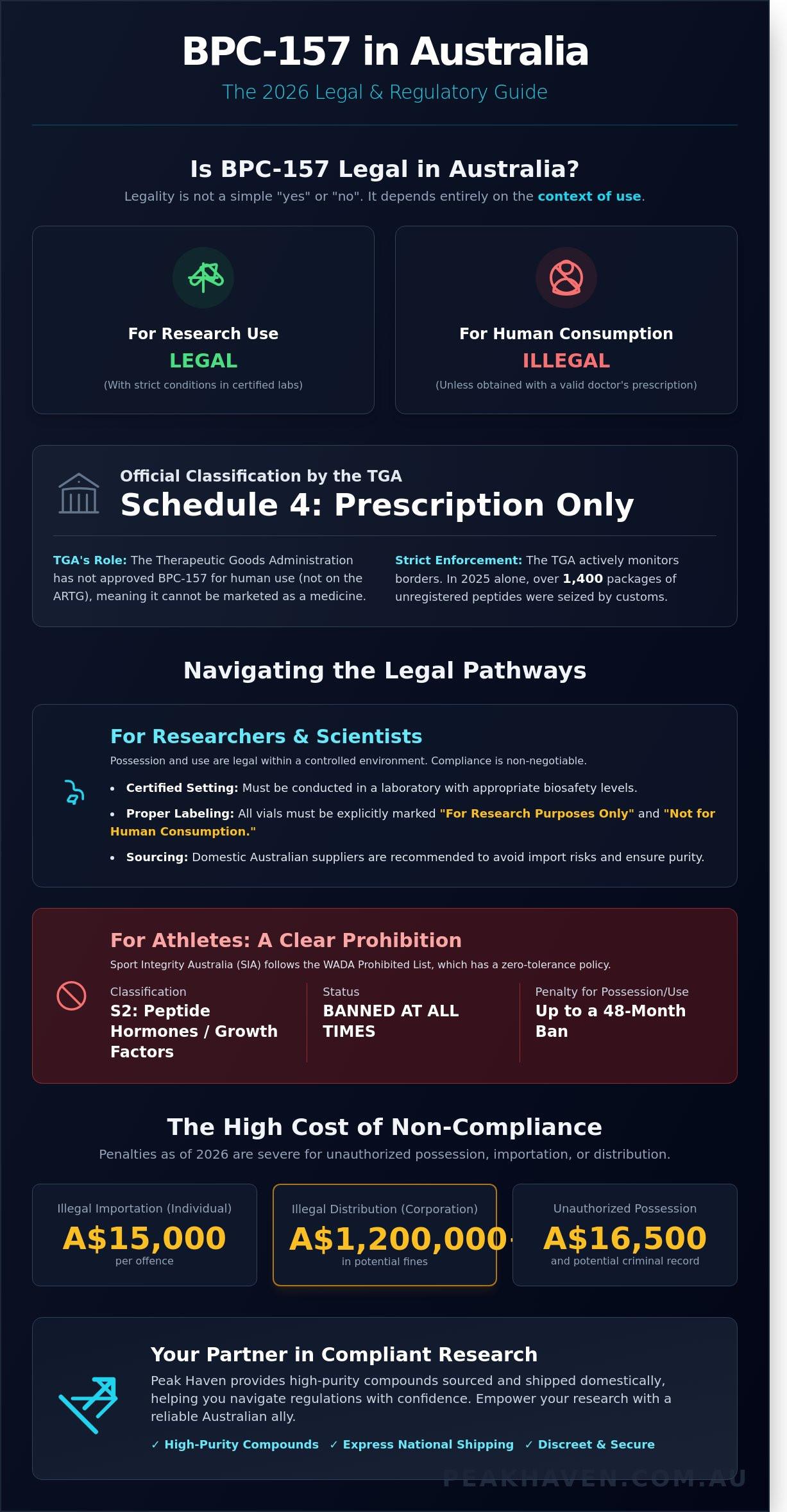
Understanding the regulatory landscape for synthetic peptides is vital for any researcher aiming to stay compliant. As of the February 2026 update to the Poisons Standard, BPC-157 remains classified as a Schedule 4 (Prescription Only) substance. This classification means that while the compound isn’t prohibited in the same way as illicit drugs, its movement and use are strictly controlled. Whether you’re a scientist in a lab or an individual looking for support, the question of is bpc 157 legal in australia depends entirely on your credentials and the intended application of the peptide.
The 2026 regulatory stance reflects a cautious approach by Australian authorities toward synthetic compounds. Legality isn’t a simple “yes” or “no” but a matter of context. For a researcher, possession is legal within a certified laboratory environment that holds the necessary permits. For a member of the public, possession is only lawful if the substance was dispensed by a pharmacist following a valid prescription from a registered Australian medical practitioner. We’ve seen these rules tighten over the last two years to ensure that safety remains the top priority for everyone involved.
The Role of the Therapeutic Goods Administration (TGA)
The TGA acts as the gatekeeper for all health-related products in Australia. Currently, BPC-157 isn’t listed on the Australian Register of Therapeutic Goods (ARTG). This absence means the TGA hasn’t evaluated the peptide for safety, quality, or clinical efficacy in humans. Since it’s not on the ARTG, it can’t be marketed or sold as a therapeutic “medicine.” The TGA actively monitors the border; in 2025 alone, customs seized over 1,400 packages of unregistered peptides. They view the import of these substances without proper permits as a significant risk to public health standards.
Understanding Schedule 4 Classifications
A Schedule 4 listing indicates that a substance requires professional medical supervision. If you’re wondering is bpc 157 legal in australia for personal study, you must recognise that “Prescription Only” status carries heavy weight. Possession without a script can lead to legal complications under state and territory laws, such as the Medicines and Poisons Act. In 2026, penalties for unauthorised distribution are severe:
- Individual fines for illegal importation can reach A$15,000 per offence.
- Corporations face much higher penalties, often exceeding A$1,200,000 for bulk distribution.
- Unauthorised possession may result in a criminal record, depending on the specific state jurisdiction.
We believe in empowering you with the right facts so you can make informed choices. Staying within the legal framework protects your research and your future, ensuring your journey toward discovery remains on the right track.
Research Use vs. Human Consumption: Navigating the Boundary
Understanding the distinction between scientific inquiry and personal use is the first step for any Australian professional. The Therapeutic Goods Administration (TGA) applies strict standards to how substances enter the country. If you’re asking is bpc 157 legal in australia, the context of your work defines the answer. Under the Therapeutic Goods Act 1989, substances intended for research must never be repurposed for human use. This boundary isn’t just a suggestion; it’s a legal requirement that protects the integrity of the scientific community.
Labeling acts as the primary safeguard for compliance. Every vial sourced for a study must clearly state “For Research Purposes Only” and “Not for Human Consumption.” While some individuals in the “biohacking” community attempt to exploit these channels, the legal risks are substantial. In 2026, penalties for the unauthorized possession or administration of Schedule 4 substances can result in fines reaching A$16,500. Determining is bpc 157 legal in australia for your specific project depends on your ability to prove a non-clinical intent. We want to help you avoid these pitfalls so you can focus on your journey toward meaningful discovery.
The WADA and Sport Integrity Australia Factor
Athletes face a different set of hurdles. Sport Integrity Australia (SIA) follows the 2026 WADA Prohibited List, which bans BPC-157 at all times. It falls under the S2 category as a peptide hormone or growth factor. Even if your research is legitimate, being a registered athlete while handling these compounds creates a conflict. A positive test or evidence of possession can lead to a 48-month ban from all organized sport. We recommend keeping your professional research and athletic pursuits entirely separate to protect your career.
The Requirement for Laboratory Settings
A valid research environment is defined by its oversight and equipment. By 2026 standards, this includes a dedicated facility monitored by an Institutional Biosafety Committee (IBC). You’ll need to maintain a meticulous audit trail. This means recording every microgram used and the specific date of each experiment. Finding the right support coordination for your regulatory needs ensures your laboratory remains compliant with Australian standards. This structured approach provides the peace of mind you need to excel in your field.
Sourcing BPC-157 Safely within Australia
Your research journey deserves a foundation of safety and reliability. While you might wonder is bpc 157 legal in australia for your specific project, finding a trustworthy source is the next vital step. We understand that the pressure to produce accurate results can be overwhelming. Choosing local suppliers reduces the burden of international logistics. In 2025, reports indicated that approximately 12% of research peptides sent from overseas were intercepted by the Australian Border Force (ABF). This leads to lost time and wasted funds. Domestic procurement offers a supportive path forward, ensuring your materials arrive securely within 24 to 48 hours via express post.
The Importance of Third-Party Testing
Integrity in research starts with the purity of your compounds. You should always demand High-Performance Liquid Chromatography (HPLC) and Mass Spectrometry (MS) reports for every batch. These documents aren’t just paperwork; they’re a promise of quality. A valid Certificate of Analysis (CoA) from a laboratory should confirm a purity level of at least 99.1%. If a supplier can’t provide a recent report dated within the last 6 months, it’s a sign to look elsewhere. Avoiding underground labs (UGLs) protects your work from contaminants that could skew your data or compromise safety. We believe that clear data empowers better outcomes for everyone involved.
Domestic vs. International Procurement
Ordering from overseas might seem cost-effective initially, but the hidden risks are high. The ABF updated its screening protocols in early 2026, increasing the scrutiny on small medicinal parcels. A domestic shipment stays within our borders, bypassing the complex permits required for international entry. Most Australian researchers now prefer local hubs because they offer A$15 to A$25 flat-rate shipping and transparent tracking. This choice gives you more control over your timeline. You won’t have to worry about your investment being held in a customs warehouse for weeks. Understanding is bpc 157 legal in australia helps you make informed decisions about your procurement strategy, ensuring your focus remains on the progress of your research and the potential it holds for the future.
Compliance Checklist for Australian Research Facilities
Managing a research space requires a steady hand and a commitment to detail. While the question of is bpc 157 legal in australia often leads to complex regulatory discussions, maintaining compliance at the facility level is straightforward when you follow a structured path. We want to help you create a safe, transparent environment for your scientific journey.
- Verify Registration: Ensure your facility is registered with the relevant state health department and meets the necessary Biosafety Level (BSL) for peptide research.
- Clear Labelling: Every vial must be marked “Not for Human Consumption” and “For Research Purposes Only” to comply with TGA Therapeutic Goods Order No. 92.
- Temperature Control: Use medical-grade refrigeration units that are monitored 24/7 to prevent peptide degradation.
- Protocol Documentation: Log every step of your reconstitution and application process to ensure your findings stand up to rigorous peer review.
- Five-Year Retention: Keep all purchase orders, batch numbers, and disposal logs for a minimum of five years to satisfy potential audits.
Safe Storage and Handling Protocols
Maintaining the stability of BPC-157 is essential for accurate data. Lyophilized powder should stay at 2?C to 8?C for long-term storage, though it remains stable at room temperature for short periods during transit. Once you introduce bacteriostatic water, the peptide becomes more fragile. This specialized water contains 0.9% benzyl alcohol, which inhibits bacterial growth for up to 28 days. After your study concludes, you must dispose of all biohazardous materials in accordance with the AS/NZS 2243.3:2022 safety standards.
Legal Documentation and Record Keeping
Transparency builds trust with regulatory bodies. Your study proposal should clearly justify the use of BPC-157 by linking it to specific physiological outcomes or cellular mechanisms. When researchers ask is bpc 157 legal in australia for specific trials, the answer often lies in your ability to produce a Material Safety Data Sheet (MSDS) and accurate batch logs on-site. If you receive an inquiry from the TGA or a state health department, having organized records shows you’re a responsible researcher. We believe that having total choice and control over your documentation protects your professional reputation.
Peak Haven: Your Partner in Australian Peptide Research
Finding a reliable supply for laboratory work requires more than just a simple transaction. It’s about a partnership built on trust. We provide high-purity BPC-157 specifically for scientific inquiry and clinical trials. In 2026, the question of whether is bpc 157 legal in australia revolves primarily around its status as a research-only compound. We prioritize security and discretion with every national express shipment. This ensures your lab receives its materials within 1 to 3 business days, regardless of your location in the country.
Our commitment to the Australian biotechnology sector goes beyond shipping. We’ve built a system that respects the integrity of your work. By sourcing locally, you bypass the risks associated with international customs and potential degradation during long-haul transit. We focus on being a steady hand for researchers who need consistent, high-grade materials to meet their project deadlines. We don’t just supply compounds; we support the progress of local innovation.
Our HPLC Testing and Quality Assurance
Our facilities in Melbourne and Sydney operate under rigorous protocols to maintain the highest standards. Every batch undergoes High-Performance Liquid Chromatography (HPLC) testing to ensure it meets a minimum 99.2% purity threshold, with many batches reaching 99.9%. We provide full transparency by making these certificates of analysis available to all our partners. This level of precision ensures that your data remains untainted by impurities. It’s the only way to achieve valid, reproducible results in modern Australian biotechnology environments where accuracy is everything.
Supporting the Australian Scientific Journey
We see ourselves as a haven for those navigating the complex regulatory landscape of peptide research. Our team provides dedicated support for both individual researchers and institutional bulk procurement needs. We understand the administrative weight of managing a lab. We streamline the logistics of acquiring high-grade compounds so you can focus on the science itself. Choosing a local partner helps strengthen Australia’s sovereign research capabilities. You can view our BPC-157 5mg research compound here to begin your next phase of discovery with a partner who values your goals as much as you do.
Empower Your Research Journey with Compliant Sourcing
Navigating the question of is bpc 157 legal in australia requires a clear understanding of the TGA?s 2026 regulatory landscape. While strict prohibitions remain for human consumption without medical oversight, legitimate Australian research facilities continue to explore this peptide’s potential under established laboratory protocols. Your work deserves a partner that values precision as much as you do. We provide the steady hand you need to manage your laboratory requirements with confidence and integrity. Every vial we supply undergoes third-party HPLC testing to ensure 99% purity levels, ensuring your data remains consistent and reliable. We’ve streamlined our process to include secure, encrypted checkouts and fast Australia-wide express shipping, often delivering to your facility within 2 business days. By focusing on compliant sourcing, you can keep your attention where it matters most, on the breakthrough discoveries that define your research. We’re here to support your path toward innovation and excellence in the lab.
Order High-Purity BPC-157 for Your Research Lab
Your dedication to scientific progress is the bridge to a more informed future, and we’re honoured to walk that path with you.
Frequently Asked Questions
Is BPC-157 legal to buy in Australia without a prescription for research?
No, you can’t legally buy BPC-157 in Australia for any purpose without a prescription from a registered medical practitioner. Under the TGA Poisons Standard updated in late 2025, BPC-157 remains a Schedule 4 Prescription Only Medicine. While some websites claim to sell it for research, individuals without a valid permit face legal risks under the Therapeutic Goods Act 1989. We want to ensure your journey toward recovery is both safe and lawful.
What happens if customs seizes my BPC-157 order in 2026?
If the Australian Border Force intercepts your order, they’ll issue a Seizure Notice under the Customs Act 1901. You’ll have 30 days to provide a valid prescription or an approved research permit. If you don’t provide these documents, the goods are destroyed; you may also receive an infringement notice with fines starting at A$3,300 for the unauthorized importation of Schedule 4 substances into the country. This process is designed to keep unregulated products out of our community.
Is BPC-157 banned by WADA for all Australians?
Yes, BPC-157 is strictly prohibited at all times for athletes under the World Anti-Doping Agency (WADA) Prohibited List. This ban applies across all competitive levels in Australia, from local weekend leagues to elite national squads. Since January 2022, WADA has classified it as a non-approved substance under section S2. Any detection in a drug test leads to a mandatory suspension, potentially ending your sporting career and affecting your long term goals.
Can I legally use BPC-157 for my own injury recovery in Australia?
You can only legally use BPC-157 for your injury recovery if a licensed Australian doctor provides a prescription for you. Determining is bpc 157 legal in australia for personal use depends entirely on having medical oversight. Sourcing peptides from “research only” vendors bypasses TGA safety protocols designed to protect 26 million Australians. We believe your health and safety should always come first when you are exploring new recovery options for your body.
What is the TGA?s current stance on BPC-157 in 2026?
The TGA maintains that BPC-157 is a Schedule 4 substance, which requires professional medical supervision for any human application. Following the December 2023 restrictions on peptide compounding, the agency has increased its surveillance on domestic suppliers throughout 2026. As of today, the TGA hasn’t approved BPC-157 for the Australian Register of Therapeutic Goods (ARTG), meaning it’s officially classified as an unapproved therapeutic good that requires special access pathways for patients.
How do I verify if a BPC-157 supplier in Australia is legitimate?
A legitimate supplier must require a valid prescription and provide an Australian Business Number (ABN) you can verify via the government’s ABN Lookup tool. Look for clinics that offer direct consultations with TGA-registered doctors to ensure your safety. If a website offers BPC-157 for “research purposes” or “not for human consumption” without a script, they aren’t operating within the legal framework of Australian law or prioritizing your well-being as a participant.
Are there specific state laws in Australia regarding peptide possession?
Yes, state laws like the Queensland Drugs Misuse Act 1986 categorize certain peptides similarly to controlled drugs, making possession without a script a criminal offense. In New South Wales, the Drug Misuse and Trafficking Act 1985 governs these substances. If you’re caught with BPC-157 without a prescription in these states, you could face local police charges carrying penalties of up to 2 years imprisonment for unauthorized possession of a restricted substance according to local regulations.
Can I buy BPC-157 as a research student for my university project?
You can buy BPC-157 for a university project only if your institution holds a valid Research Permit and an Office of Chemical Safety license. The university’s ethics committee must approve your specific study before any purchase occurs. Understanding is bpc 157 legal in australia for academic work requires checking the specific health department requirements in your state to ensure your project complies with the strict 2026 regulations for handling Schedule 4 chemicals safely.

Disclaimer
The products discussed in this article are intended strictly for laboratory and research purposes only. They are not intended for human consumption, therapeutic use, or as dietary supplements. Nothing in this article should be interpreted as medical advice, a diagnosis, or a recommendation for treatment. Always consult a qualified healthcare professional for any medical concerns.
Peak Haven supplies research-grade peptides exclusively for scientific and clinical research use. All products undergo independent third-party HPLC testing to verify purity and composition. By purchasing from Peak Haven, you confirm that products will be used solely for legitimate research purposes in accordance with all applicable Australian laws and regulations.
The information presented in this article is based on published scientific literature and is provided for educational purposes only. Peak Haven makes no claims regarding the efficacy or safety of any compound for human use. Individual research results may vary. References to studies or research findings do not constitute endorsement of any specific application.