
How to Present Peptide Data with Confidence: A 2026 Researcher?s Guide
By Peak Haven12 min read

What if the most rigorous statistical model in your mass spectrometry analysis is rendered meaningless by a subtle 5% variance in your peptide?s initial purity? You likely understand that the weight of your laboratory findings rests entirely on the clarity and reproducibility of your results. It’s a common frustration to feel a sense of uncertainty when translating raw HPLC data into a format ready for publication, especially when False Discovery Rates (FDR) complicate your conclusions. This guide will empower you with the tools to master how to present peptide data with confidence by bridging the gap between complex software outputs and laboratory-verified standards.
At Peak Haven, we believe your research journey deserves a steady hand and reliable data. We’ll provide a clear framework for interpreting mass spec scores and show how third-party HPLC testing and our Australian-based shipping ensure your work meets 2026 global standards for excellence. By the end of this article, you’ll see how aligning statistical confidence with high-purity research peptides Australia can transform your next presentation into an authoritative statement of truth.
Key Takeaways
- Understand why 98%+ HPLC purity is the essential benchmark for ensuring the integrity and reproducibility of your laboratory research findings.
- Master the use of False Discovery Rates (FDR) and Decoy Databases to validate sequences, providing a clear roadmap on how to present peptide data with confidence.
- Learn to create professional visualisations, such as Volcano Plots and HPLC chromatograms, that effectively communicate statistical significance and fold changes.
- Discover the critical importance of sourcing third-party HPLC-tested compounds from within Australia to guarantee your data is built on a foundation of verified high-purity peptides.
The Foundation of Confidence: Verification and HPLC Purity
Scientific confidence isn’t just a feeling; it’s a measurable metric based on data integrity and the physical properties of your compounds. In laboratory settings, your results are only as strong as the materials you use. When you’re learning how to present peptide data with confidence, the starting point is always the rigorous verification of your research materials. High-purity peptides ensure that the biological responses you observe are actually caused by the peptide itself, not by residual solvents, salts, or truncated sequences that shouldn’t be there.
To better understand the analytical techniques used to verify these compounds, watch this helpful video:
Industry standards for credible laboratory studies dictate a minimum of 98% purity. Anything less introduces unwanted “noise” during sensitive analytical procedures like peptide mass fingerprinting. These impurities can trigger false positives or obscure the true mass spectrometry peaks, making it nearly impossible to replicate your findings in future trials. Peak Haven understands that for Australian researchers, having a clear baseline is the only way to ensure that “how to present peptide data with confidence” becomes a reality rather than a challenge.
Why HPLC Tested Peptides are Non-Negotiable
High-Performance Liquid Chromatography (HPLC) is the gold standard for peptide characterisation. This process separates a mixture into its individual components by passing it through a column under high pressure, allowing researchers to see the exact percentage of the target compound. While internal testing provides a preliminary check, independent third-party verification offers an unbiased layer of security. It confirms that the sequence and purity match the label, which is vital for any researcher aiming to publish or present findings. At Peak Haven, we ensure all research peptides Australia buyers receive have undergone this rigorous external validation.
Linking Chemical Purity to Statistical Reproducibility
Batch-to-batch consistency is the backbone of longitudinal research. If one batch is 99% pure and the next is 95%, your data loses its longitudinal validity. Every shipment should include a detailed Certificate of Analysis (COA) to document these standards and provide a paper trail for your study. For those operating within the local regulatory landscape, understanding the Peptides Australia Guide helps ensure your laboratory protocols align with national expectations for research excellence. This level of transparency allows you to account for every milligram in your study, ensuring your statistical models remain robust and your conclusions remain beyond reproach.
Decoding Statistical Confidence in Peptide Identification
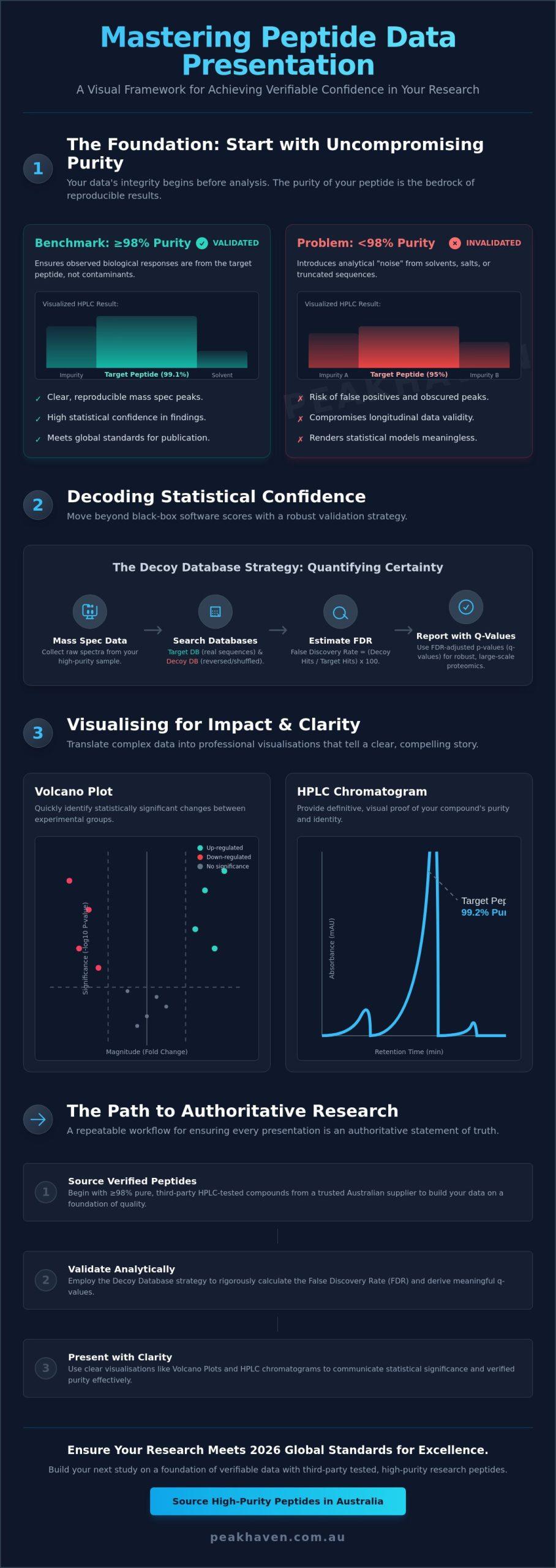
Establishing rigorous proof for your findings is the cornerstone of how to present peptide data with confidence. In the Australian research landscape, where precision is non-negotiable, we rely on the False Discovery Rate (FDR) to quantify the likelihood of incorrect peptide-spectrum matches. Researchers typically use the Decoy Database strategy, which involves searching spectra against a database of reversed or shuffled sequences. If a match occurs in the decoy set, it’s a known error. This allows you to estimate the error rate in your actual target data with high precision.
To ensure the integrity of these matches, researchers often cross-reference mass spectrometry results with HPLC analysis for peptide purity. This validation step confirms that the chemical entity you’re studying matches the expected profile. While p-values indicate the probability of a single match occurring by chance, q-values are far more useful for large-scale proteomics. The q-value is essentially the FDR-adjusted p-value, providing a measure of how many false positives you can expect within a specific list of identified peptides.
A frequent pitfall in data presentation is over-reliance on proprietary confidence scores found in automated laboratory software. These scores are often black-box algorithms. They don’t always account for specific experimental variances or sample preparation nuances. You should treat these scores as helpful guides rather than absolute truths, always backing them up with manual inspection of the spectra for key diagnostic ions.
Understanding FDR and Posterior Error Probability
In large-scale studies, FDR provides a global error rate for your entire dataset. However, the Posterior Error Probability (PEP) offers a more granular look. It calculates the probability that a specific, individual peptide identification is wrong. Adhering to a strict 1% FDR threshold remains the gold standard for peer-reviewed journals in 2026. This threshold strikes a necessary balance between data depth and statistical reliability, ensuring your results stand up to international scrutiny.
Handling Outliers in Peptide Research Data
Data variance often stems from the bench rather than the biology. Identifying outliers requires a systematic approach, such as using Tukey?s fences or Z-score analysis. If you’re removing data, you must justify it based on technical errors, such as a blocked HPLC column or inconsistent pipetting. Improper reconstitution is a leading cause of data noise. Using high-quality bacteriostatic water helps maintain compound stability during the analysis window. This reduces the risk of degradation-induced outliers that can compromise your study’s reproducibility.
If you’re ready to elevate your research standards, you can explore our range of HPLC tested peptides to ensure your data begins with the highest quality materials.
Visualising and Reporting Peptide Research Findings
Clear reporting is the backbone of any successful study. You need to transform raw output into a narrative that colleagues and reviewers can trust immediately. Learning how to present peptide data with confidence involves more than just pasting a chart into a slide; it requires a structured approach to transparency. When you document your findings, start with high-resolution HPLC chromatograms. A professional report should feature a clean baseline, clearly showing the primary peak and any minor impurities. This level of detail demonstrates your commitment to using pharmaceutical grade peptides in your research environment.
Volcano plots are another vital tool for researchers handling large datasets. These plots allow you to illustrate fold changes against p-values. By plotting the negative log of the p-value on the y-axis and the log of the fold change on the x-axis, you can highlight peptides that show both high magnitude changes and strong statistical significance. This visual shorthand helps your audience identify key trends without getting lost in raw spreadsheets.
The Essential Components of a Peptide Data Table
A well-structured data table is your best tool for building credibility. It should act as a definitive reference point for every sample used in your study. Your table must include the Peptide Sequence, Observed Mass, and Theoretical Mass in Daltons. Including a column for statistical confidence in peptide identification ensures your results are backed by rigorous mathematical frameworks. Always report the purity level, ideally verified by third-party HPLC testing. For total traceability, include the specific lot number from your Peak Haven order. This allows other researchers to replicate your conditions exactly, which is a hallmark of high-quality Australian research.
Creating Effective Visual Aids for Presentations
When you’re presenting to a broader audience, simplify your mass spec graphs. Focus on the parent ion peak rather than every minor fragment. This prevents the “noise” from distracting your viewers. Heat maps are particularly effective for visualising how a peptide stack for research affects different cellular markers over time. Colour gradients provide an intuitive way to show activity levels across multiple samples at once. It’s vital to label every axis with the correct units, such as m/z for mass-to-charge ratios or ppm for mass accuracy. These small details ensure your peers understand how to present peptide data with confidence while maintaining scientific integrity.
Finally, your ‘Materials and Methods’ section must be transparent. State that your research peptides Australia were sourced from Peak Haven and mention the storage conditions, such as temperature and reconstitution buffers used. This level of detail protects your work from scrutiny and empowers others to build upon your discoveries.
Ready to elevate your next study with high-purity compounds? Explore the full range of HPLC-tested peptides at Peak Haven today.
Ensuring Data Integrity with HPLC-Tested Peptides
Your research findings are only as reliable as the compounds used in your laboratory. Peak Haven serves as a dedicated ally for the Australian scientific community, providing a steady hand in the procurement of high-purity research peptides. We understand that when you’re preparing to share your results, the integrity of your starting material is paramount. Sourcing from a local, trusted provider ensures that your data reflects the true potential of the compound rather than the effects of degradation or impurities. This reliability allows you to stand behind your work with absolute certainty.
The Peak Haven Quality Assurance Framework
Every vial we supply undergoes rigorous third-party HPLC testing to verify its purity and molecular mass. High-Performance Liquid Chromatography remains the gold standard for identifying chemical composition; having these reports on hand is essential for those learning how to present peptide data with confidence. When your audience asks about the specificity of your results, you can point to verified purity levels. Our framework includes:
- Independent verification of peptide sequence identity.
- Purity assessments to ensure the absence of synthesis by-products.
- Australian-based express shipping to minimize time in transit.
- Temperature-controlled handling to preserve structural stability.
Our commitment to quality extends to our logistics. We utilize express shipping across Australia to maintain the structural integrity of sensitive sequences. This process prevents the thermal stress and mechanical agitation that often occurs during long-haul international transit, ensuring the peptide arrives at your lab in its optimal state for reconstitution.
Streamlining Your Laboratory Procurement
Sourcing your supplies locally within Australia eliminates the unpredictability of customs delays and the risk of biological degradation during extended transit times. Researchers can easily access specific compounds like Retatrutide 20mg for metabolic research or explore synergistic effects with BPC-157 + TB-500 blends. By choosing a partner that prioritizes transparency and reliability, you’re empowered to focus on the science itself.
Our streamlined ordering process is designed to reduce administrative burden, allowing you to move from hypothesis to data collection faster. We provide the technical documentation necessary to support your laboratory’s compliance and reporting requirements. Browse our full catalogue today at peakhaven.com.au to find the precise tools needed for your next breakthrough.
Empowering Your Future Research Breakthroughs
Mastering how to present peptide data with confidence requires a blend of rigorous statistical analysis and unshakeable material integrity. Your findings are only as strong as the compounds you start with. By integrating third-party HPLC testing on every batch, you ensure that every chromatogram and data point reflects the true potential of your study. This commitment to pharmaceutical grade research compounds removes the guesswork, allowing you to focus on decoding complex cellular mechanisms and publishing results that stand the test of time. Reliable data isn’t just about the final graph; it’s about the verifiable purity that supports every conclusion you draw in the lab.
We understand the dedication required to maintain high standards in the Australian scientific community. That’s why we provide secure Australian express shipping to keep your projects moving at the pace of innovation. When you choose verified quality, you’re choosing a path of clarity and professional reliability. We’re proud to be your partner in this journey toward more impactful, reproducible science. Your next major discovery is within reach, and we’re here to help you secure the foundation of your research.
Explore HPLC-Tested Research Peptides at Peak Haven
Frequently Asked Questions
What is a good confidence score for peptide identification?
A confidence score of 95% or higher is the standard benchmark for reliable peptide identification in peer-reviewed journals. This threshold ensures your results are statistically significant and reduces the likelihood of false positives in your dataset. When you buy research peptides Australia from Peak Haven, you receive documentation that supports these high standards. Achieving this score allows you to share your findings with the certainty required for high-impact publications.
How do I calculate the False Discovery Rate for my peptide data?
You calculate the False Discovery Rate (FDR) by using a decoy database search strategy to estimate the number of incorrect assignments. Divide the number of decoy hits by the total number of target hits to determine the percentage of potential errors. Most researchers aim for an FDR of less than 1% to maintain strict data integrity. Understanding these metrics is vital when learning how to present peptide data with confidence during your next peer review or grant application.
Why does HPLC purity matter if I am using high-resolution mass spectrometry?
HPLC purity matters because mass spectrometry identifies what is present, but it doesn’t always quantify the ratio of impurities as effectively as chromatography. High-resolution MS might detect the correct molecular weight; however, HPLC reveals truncated sequences or residual solvents that could skew your results. Peak Haven provides HPLC tested peptides Australia with purity levels often exceeding 98%. This ensures your cellular assays aren’t compromised by unknown contaminants that MS might overlook.
Can I present data from blended peptides like BPC-157 and TB-500?
You can present data from peptide stacks for research, such as BPC-157 and TB-500, provided you report the precise molar ratio and individual purity of each component. Transparency is key when documenting synergistic effects in laboratory models. We recommend sourcing these as individual pharmaceutical grade peptides to ensure your baseline measurements remain accurate. Clearly stating the combined concentration helps other researchers replicate your study with the same level of precision.
What should be included in a peptide research COA?
A comprehensive Certificate of Analysis (COA) must include the HPLC chromatogram, the Mass Spectrometry report, the batch number, and the final purity percentage. It should also list the theoretical mass versus the observed mass to confirm the peptide’s identity. Every order from Peak Haven includes access to these third-party verification documents. Having this data on hand simplifies the process of how to present peptide data with confidence to your ethics committee or laboratory supervisor.
How do I report the concentration of reconstituted peptides in a study?
Report the concentration of reconstituted peptides using molarity, such as micromolar (?M) or nanomolar (nM), rather than just milligrams per millilitre. You must also specify the solvent used, such as sterile water or phosphate-buffered saline, as this affects solubility and stability. Since we offer fast Australian-based shipping, your laboratory can maintain a consistent supply for longitudinal studies. Precise reporting ensures your data is accessible and reproducible for the global scientific community at peakhaven.com.au.

Disclaimer
The products discussed in this article are intended strictly for laboratory and research purposes only. They are not intended for human consumption, therapeutic use, or as dietary supplements. Nothing in this article should be interpreted as medical advice, a diagnosis, or a recommendation for treatment. Always consult a qualified healthcare professional for any medical concerns.
Peak Haven supplies research-grade peptides exclusively for scientific and clinical research use. All products undergo independent third-party HPLC testing to verify purity and composition. By purchasing from Peak Haven, you confirm that products will be used solely for legitimate research purposes in accordance with all applicable Australian laws and regulations.
The information presented in this article is based on published scientific literature and is provided for educational purposes only. Peak Haven makes no claims regarding the efficacy or safety of any compound for human use. Individual research results may vary. References to studies or research findings do not constitute endorsement of any specific application.