
How to Convince Your PI to Buy Quality Reagents: A Researcher's Guide
By Peak Haven12 min read
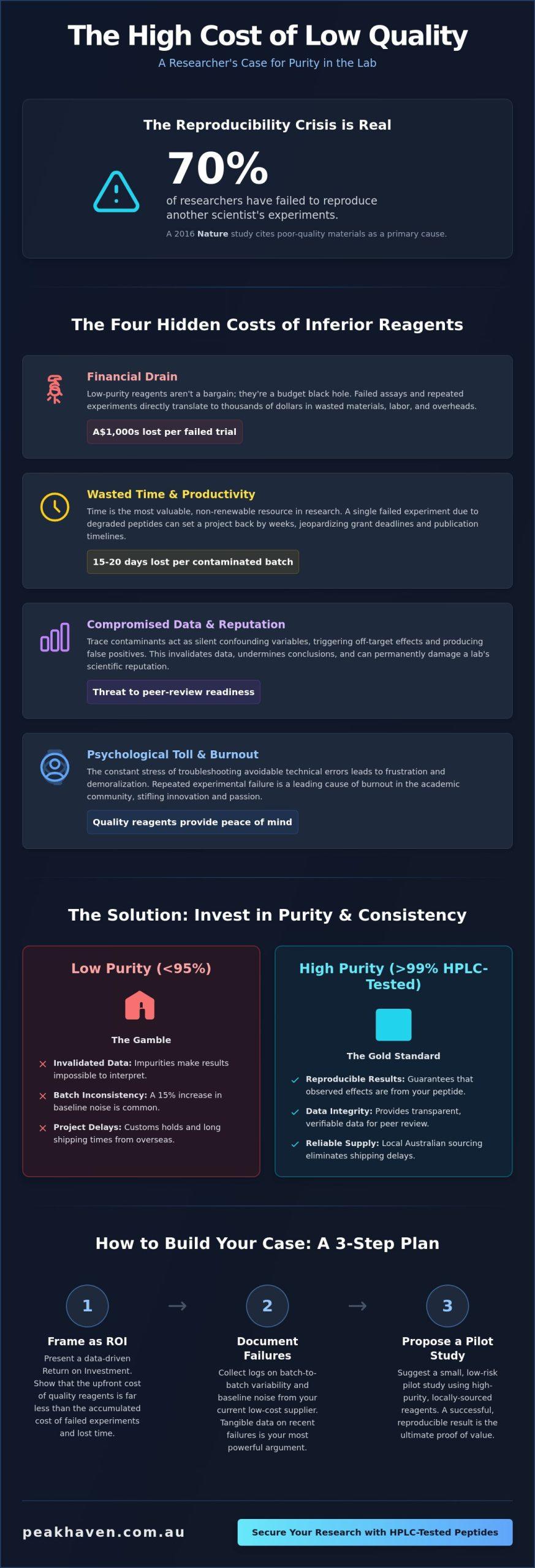
A 2016 survey published in Nature revealed that 70% of researchers have failed to reproduce another scientist’s experiments, often due to poor-quality materials. It’s a frustrating reality when months of your work vanish because of batch-to-batch variability or impure compounds. You know that the success of your project depends on the integrity of your materials, but learning how to convince your PI to buy quality reagents requires more than just a request; it requires a data-driven business case. We understand the pressure of the reproducibility crisis and the stress of waiting weeks for overseas shipments to clear customs.
In this guide, we’ll show you how to master the art of securing high-purity, pharmaceutical grade peptides that protect your lab’s reputation and your path to publication. You’ll learn to frame the cost of premium reagents against the A$1,000s lost in failed assays and wasted time. We’ll also explore why choosing Peak Haven’s HPLC tested peptides Australia can eliminate shipping delays and ensure your results remain consistent. By the end of this article, you’ll have the tools to turn your PI into a partner in quality, ensuring your research stands on a foundation of absolute purity.
Key Takeaways
- Identify how hidden impurities in low-cost reagents act as confounding variables that can compromise your cellular signaling data and lab reputation.
- Learn how to convince your PI to buy quality reagents by using a data-driven ROI framework that accounts for the A$ cost of lost laboratory time and repeated experiments.
- Discover the technical requirements for HPLC-tested peptides and how batch-to-batch consistency is vital for achieving reproducible results in Australian research.
- Master the structure of a high-impact procurement proposal, including how to present a one-page executive summary and a low-risk pilot study design to your supervisor.
- Understand the strategic advantage of sourcing third-party tested reagents locally to ensure your project remains on track with reliable, research-grade materials.
The Hidden Costs of Low-Purity Reagents in Laboratory Research
Reagent quality is the vital intersection of chemical purity, molecular stability, and batch-to-batch consistency. It’s the foundation upon which every successful study is built. When you’re exploring how to convince your PI to buy quality reagents, it’s helpful to frame the discussion around risk management rather than just upfront price points. Low-quality reagents often fail to meet established reagent-grade purity standards, introducing variables that are impossible to control.
The “time-cost” of using inferior materials is often the most expensive line item in a lab’s budget. A failed trial caused by degraded peptides can easily waste 15 to 20 days of active research time. In the Australian research context, where grants are highly competitive, losing a month of productivity represents thousands of dollars in lost labor and laboratory overheads. Ensuring stability is a key part of this equation. For instance, using bacteriostatic water for peptide reconstitution helps maintain molecular integrity, preventing the premature degradation that leads to these costly restarts.
The ongoing reproducibility crisis in science further emphasizes the need for high-tier supplies. A 2016 study published in Nature found that 70% of researchers failed to reproduce another scientist’s results. By choosing HPLC tested peptides Australia, you provide your project with the transparency needed for successful peer review and long-term career progression. When you are looking at how to convince your PI to buy quality reagents, showing them how quality protects the lab’s reputation is a powerful argument.
Confounding Variables and Data Integrity
Trace contaminants often act as silent confounding variables in sensitive assays. In cellular signaling studies, even a minute amount of an impurity can trigger off-target effects, leading to false positives or misleading results. Using pharmaceutical grade peptides ensures that the biological responses you observe are actually caused by the peptide under investigation. Verification through High-Performance Liquid Chromatography (HPLC) is essential to identify chemical artifacts that could otherwise compromise your data integrity and peer-review readiness.
The Psychological Toll of Experimental Failure
Beyond the financial impact, repeated experimental failure due to poor reagent quality takes a heavy toll on a researcher?s well-being. It’s a leading cause of burnout in the academic community. There’s a profound sense of empowerment that comes from having “peace of mind” during high-stakes, long-term studies. When you buy research peptides Australia from reliable sources, you’re not just buying a chemical; you’re securing the ability to focus on innovation. Reliable reagents act as a steady hand, allowing you to navigate complex systems without the constant stress of avoidable technical errors. This partnership between quality sourcing and researcher talent is what drives true scientific discovery.
Building a Scientific Case for HPLC Tested Peptides
When you’re preparing to discuss procurement with your Principal Investigator (PI), data is your most effective tool. To understand how to convince your PI to buy quality reagents, you should start by documenting the specific technical thresholds of your protocol. If your study requires >99% purity to maintain cellular signaling integrity, then a reagent at 95% purity isn’t just “slightly lower quality”; it’s a variable that can invalidate your entire dataset. Collect your recent logs on batch-to-batch variability. If your current low-cost supplier has caused a 15% increase in baseline noise over the last three months, that’s a tangible loss of time and resources.
High-Performance Liquid Chromatography (HPLC) remains the gold standard for peptide verification in 2026. Think of HPLC as a molecular filter that pushes your sample through a specialised column at high pressure. Different molecules move at different speeds based on their chemical properties, allowing you to see exactly what’s in your vial. For a deeper look at the Australian regulatory landscape and how these standards protect your research, you can explore our Peptides Australia guide.
What HPLC Testing Actually Proves
There’s a critical difference between chemical identity and purity. Identity confirms that the molecule is actually the peptide you ordered, while purity measures the concentration of that specific molecule against contaminants. Third-party HPLC testing is essential because it removes supplier bias, providing an objective certificate of analysis (COA) from an independent lab. This transparency ensures that your experimental variables remain controlled, allowing you to focus on your findings rather than troubleshooting your materials.
Comparing Purity Levels: 95% vs. 99%
A 4% difference in purity might seem negligible on a balance sheet, but it can be catastrophic in the lab. In sensitive metabolic research involving compounds like Retatrutide 20mg, even minor impurities can bind to unintended receptors, leading to a 100% failure rate in specific assays. These failed experiments represent a massive financial drain. When you factor in The Cost of Quality, it’s clear that cheaper reagents often lead to higher long-term expenses through wasted labour and lost materials.
Watch for these red flags in cheap reagent COAs:
- Missing or blurry HPLC chromatograms.
- COAs that don’t list a specific batch or lot number.
- Purity claims that aren’t backed by third-party laboratory seals.
- Significant discrepancies between the theoretical and observed mass in Mass Spectrometry (MS) reports.
If you’re ready to elevate your lab’s standards, we invite you to explore our range of HPLC-tested research peptides today.
The ROI Framework: Proving Quality Saves Money
When you’re trying to figure out how to convince your PI to buy quality reagents, you need to speak the language of the laboratory budget. It’s rarely about the sticker price of a single vial; it’s about the total cost of the experimental workflow. A single “lost week” in an Australian research facility can easily cost upwards of A$2,500. This figure includes PhD stipends, technician wages, and institutional overheads. If a bargain-bin reagent causes a protocol to fail, that initial A$150 saving becomes a massive financial drain on the lab’s resources.
The “Grant Funding Risk” is your strongest leverage in these discussions. The National Health and Medical Research Council (NHMRC) and the Australian Research Council (ARC) place immense value on reproducibility. Producing non-reproducible data because of inconsistent peptide purity doesn’t just waste time. It actively jeopardises future grant renewals and your lab’s reputation. Framing quality reagents as a risk-mitigation strategy for high-impact publications is a powerful way to align your needs with your PI’s long-term goals.
The Math of Experimental Success
Consider a hypothetical 12-month study. Using a discount reagent might save the lab A$1,200 annually. However, if that reagent leads to just one failed three-month longitudinal study, the losses are staggering. You’ve wasted thousands in plasticware, media, and specialised imaging fees. High-purity options like MOTS-c 10mg ensure that every microgram contributes to a valid data point. This reliability increases your data yield per dollar spent, making the “premium” choice the most economical one.
Addressing the “Tight Budget” Objection
If your PI points to a shrinking budget, suggest bulk procurement. Buying larger quantities of HPLC-tested peptides often triggers volume discounts, lowering the price per unit while maintaining pharmaceutical-grade standards. You should also highlight the value of local Australian support. Working with a domestic provider reduces the risk of costly downtime caused by international shipping delays or customs seizures. Consistent results lead to faster publication cycles, which is the ultimate currency in academia. By choosing quality laboratory supplies, you’re investing in the lab’s long-term productivity and scientific impact.
How to Present Your Procurement Proposal to Your PI
Your PI manages multiple projects and tight budgets simultaneously. They need clear data, not just requests. When you’re figuring out how to convince your PI to buy quality reagents, start with a concise one-page Executive Summary. This document should contrast the potential A$2,000 lost in labor and consumables from a failed experiment against the modest investment in verified compounds. Clarity is your best tool here.
Suggest a small-scale pilot study to bridge the gap between hesitation and approval. By comparing two reagent sources over a 14-day trial, you provide empirical evidence of performance. This approach lowers the PI’s perceived risk while demonstrating your commitment to methodological rigour. It’s much easier to approve a small trial than a bulk order.
Focus on the logistical benefits of local sourcing. Overseas shipments often face three-week customs delays or temperature fluctuations during transit that can degrade sensitive peptides. Choosing a supplier with Australian-based shipping ensures your project milestones stay on track and your reagents arrive in peak condition. Address safety early by ensuring the proposal states all compounds are strictly for laboratory-use and comply with institutional safety protocols. For high-stakes research, we recommend using HPLC tested peptides Australia to ensure purity levels meet the 98% or higher standard required for reproducible results.
Choosing the Right Supplier for the Proposal
Peak Haven?s third-party verification serves as a powerful shield for your PI. Each batch comes with independent HPLC and MS reports, which removes the guesswork from your data. You can highlight that express shipping within Australia eliminates the unpredictability of international logistics and the frustration of lost packages. For multi-compound studies, mention the availability of research-specific stacks like the Total Transformation Stack. This allows the lab to acquire a comprehensive suite of reagents through a single, streamlined procurement process, saving time on administrative paperwork.
The Final Pitch: Choice and Control
Frame this request as a partnership where you take the lead on reagent vetting. You’re taking responsibility for the quality of the inputs to ensure the lab’s resources are used efficiently. Remind your PI that high-quality reagents protect the lab?s most valuable asset: its reputation for excellence. Reliable data leads to successful grants and high-impact publications, which is the ultimate goal for any research group. When you’re ready to present the final options, direct your PI to view the full product range and purity certifications at peakhaven.com.au. Taking this proactive step shows you’re invested in the long-term success of the laboratory’s work.
Securing the Future of Your Research Results
Choosing high-purity reagents isn’t just about the immediate experiment; it’s about protecting your lab’s long-term reputation and funding. When you present the ROI of reliable data, you’re showing your PI that quality reagents actually save the lab money by reducing repeat trials and troubleshooting hours. Understanding how to convince your PI to buy quality reagents involves highlighting the cost of failed assays, which often exceeds the price difference of premium supplies. Reliable data leads to faster publications and more successful grant applications in the competitive Australian research landscape.
We’re here to support your journey toward scientific excellence with materials you can trust. Peak Haven provides third-party HPLC purity verification for every batch, ensuring your work remains precise and reproducible. We offer fast Australia-wide express shipping and dedicated support specifically for Australian research institutions. Our team understands the unique pressures of the local scientific community and acts as a steady partner in your procurement process.
Explore our range of HPLC-tested research peptides and secure the quality your data deserves.
Your next breakthrough starts with the right foundation.
Frequently Asked Questions
How do I explain the importance of HPLC testing to a non-chemist PI?
You can explain HPLC testing as a quality insurance policy that protects the lab’s most valuable asset: its data. High-Performance Liquid Chromatography provides a digital fingerprint of a substance, confirming that the research peptides Australia labs use are free from contaminants that could skew results. If a reagent is only 80% pure, 20% of your experiment involves unknown variables, which often leads to a 100% loss of time and resources.
Can I use grant money to buy premium peptides in Australia?
Yes, you can typically use grant funds from bodies like the Australian Research Council (ARC) to purchase high-quality consumables. Investing in pharmaceutical grade peptides is a justifiable expense because it reduces the risk of experimental failure, which aligns with the NHMRC’s focus on research integrity and efficiency. When you buy peptides Australia researchers trust, you’re choosing a path that respects the taxpayer’s investment by producing reliable, peer-review-ready results.
What happens if my PI insists on the cheapest possible supplier?
If your PI chooses the cheapest supplier, you risk dealing with batch-to-batch inconsistency that can invalidate months of work. Low-cost reagents often lack the rigorous third-party HPLC testing that Peak Haven provides, meaning you might spend A$500 to save A$50, only to lose A$5,000 in labor costs when the experiment fails. Understanding how to convince your PI to buy quality reagents involves showing them that the “cheapest” option is often the most expensive in the long run.
Is it better to buy in bulk or order reagents as needed?
It’s generally better to order reagents as needed unless you have specialized -80?C storage and a high turnover rate. Peptides can begin to degrade within 30 days if they aren’t stored correctly, so buying in bulk might lead to using sub-par materials by the end of the year. Peak Haven offers fast Australian-based shipping, which allows you to maintain a fresh supply of HPLC tested peptides Australia without the risks associated with long-term storage.
How do I track the “cost of failure” in my lab notebook to prove my case?
You can track the cost of failure by recording every hour spent on a failed trial and multiplying it by your hourly stipend or salary rate. Include the cost of other consumables like plates, media, and pipette tips, which can easily exceed A$1,200 per failed run. When you present a spreadsheet showing that a single batch of low-quality reagents cost the lab 45 hours of work, the argument for premium supplies becomes undeniable.
Are there specific Australian regulations for importing research reagents?
Australia has strict regulations managed by the Australian Industrial Chemicals Introduction Scheme (AICIS) and the Department of Agriculture, Fisheries and Forestry (DAFF). Importing reagents yourself often involves complex permits and potential 14 day customs delays. Choosing a local provider like Peak Haven simplifies this journey, as we handle the regulatory compliance and provide lab-ready materials directly from our Australian facilities. Explore our full range of research-grade products at peakhaven.com.au.

Disclaimer
The products discussed in this article are intended strictly for laboratory and research purposes only. They are not intended for human consumption, therapeutic use, or as dietary supplements. Nothing in this article should be interpreted as medical advice, a diagnosis, or a recommendation for treatment. Always consult a qualified healthcare professional for any medical concerns.
Peak Haven supplies research-grade peptides exclusively for scientific and clinical research use. All products undergo independent third-party HPLC testing to verify purity and composition. By purchasing from Peak Haven, you confirm that products will be used solely for legitimate research purposes in accordance with all applicable Australian laws and regulations.
The information presented in this article is based on published scientific literature and is provided for educational purposes only. Peak Haven makes no claims regarding the efficacy or safety of any compound for human use. Individual research results may vary. References to studies or research findings do not constitute endorsement of any specific application.