
Setting up a science lab, whether for a classroom or serious research, means getting the right science lab supplies. It’s not just about filling shelves; it’s about having the tools that let you do good work. From measuring things precisely to keeping everyone safe, the right equipment makes all the difference in getting reliable results and making discoveries. Let’s look at what you’ll need to get your experiments going.
Key Takeaways
- Accurate measurement tools like digital balances, graduated cylinders, and pH meters are vital for precise scientific work.
- Basic glassware such as beakers, flasks, and test tubes, along with consumables, are fundamental for conducting experiments.
- Safety is paramount, requiring personal protective gear, emergency equipment, and secure chemical storage solutions.
- Advanced research may call for specialized items like microscopes, incubators, and spectrometers for detailed analysis.
- Integrating technology, from data collection tools to simulation software, can greatly aid research and learning in a science lab.
Essential Measurement And Analysis Science Lab Supplies
When you’re setting up for an experiment, getting accurate measurements is pretty much the first step. Without reliable data, your results can be way off, and then what was the point? This section covers the gear that helps you get those numbers right.
Precision Digital Balances
This is where you weigh things. Seriously, it’s that important. You’ll find different types, from basic ones for general use to super-sensitive models that can measure down to a fraction of a milligram. The accuracy of your balance directly impacts the reliability of your results. Make sure you get one that fits the scale of what you’re measuring. For instance, if you’re working with small amounts of reagents, a milligram balance is a must. Always calibrate your balance before use; it’s a simple step that makes a big difference.
Accurate Liquid Handling Tools
Measuring liquids is a whole other ballgame. You’ve got your graduated cylinders for rougher estimates, but for anything needing real precision, you’ll want pipettes. There are volumetric pipettes for dispensing a single, exact volume, and graduated pipettes that let you measure variable amounts. Then there are micropipettes, which are fantastic for handling tiny volumes, often in the microliter range. Using the right tool and technique here prevents errors that can cascade through your experiment.
Here’s a quick look at common liquid handling tools:
- Volumetric Pipettes: Best for dispensing one specific, accurate volume.
- Graduated Pipettes: Useful for measuring and dispensing variable volumes.
- Micropipettes: Ideal for very small volumes (microliters), often adjustable.
- Graduated Cylinders: Good for approximate volumes, less precise than pipettes.
Temperature and pH Monitoring Devices
Lots of reactions are sensitive to temperature and acidity. A simple thermometer is often enough, but for more controlled environments, you might need a digital thermometer or even a data logger that records temperature over time. For pH, a pH meter is your go-to. Litmus paper can give you a general idea, but a meter provides a precise numerical value. Keeping these parameters in check is key to reproducibility.
Monitoring environmental conditions like temperature and pH is not just about getting a number; it’s about controlling the variables that can significantly alter the outcome of your experiment. Small fluctuations can sometimes lead to completely different results, so having reliable monitoring tools is non-negotiable for serious scientific work.
Fundamental Glassware And Consumables For Experiments
You can’t do much science without some basic containers and things you use up. These items are the workhorses of any lab, used for holding, mixing, heating, and observing all sorts of substances. Getting the right kind matters for accurate results and safe practices.
Beakers, Flasks, and Test Tubes
These are probably the most common glass items you’ll see. Beakers are like sturdy cups with a lip for pouring, good for general mixing and heating. Flasks come in different shapes ? think Erlenmeyer flasks with their conical bodies for swirling without spilling, or round-bottom flasks for even heating. Test tubes are smaller, for holding tiny amounts or running quick reactions. They’re not usually for precise measurements, but they’re incredibly useful for a lot of day-to-day tasks.
- Beakers: Great for holding, mixing, and heating liquids. They have volume markings, but they aren’t super precise.
- Flasks: Come in various shapes for specific jobs like swirling (Erlenmeyer), boiling (round-bottom), or storing (reagent).
- Test Tubes: Small, for holding small samples, heating, or culturing.
It’s a good idea to have a range of sizes for each type of glassware. You’ll use small ones for delicate work and larger ones for preparing bigger batches of solutions.
Petri Dishes and Microscope Slides
Petri dishes are shallow, lidded dishes, usually used for growing cultures like bacteria or fungi. They provide a flat surface and a contained environment. Microscope slides are small, thin pieces of glass that you place a sample on so you can look at it under a microscope. You’ll often use coverslips, which are even smaller pieces of glass, to protect the sample and the microscope lens.
Hygiene and Contamination Prevention Supplies
Keeping things clean is a big deal in science. You’ll need things like disposable gloves to protect yourself and your samples from contamination. Pipette tips, which fit onto pipettes for transferring liquids, should also be disposable to avoid cross-contamination between experiments. Wipes and cleaning solutions are also important for keeping surfaces and equipment tidy. Using clean, single-use items where appropriate is key to getting reliable results.
- Disposable gloves (nitrile or latex)
- Disposable pipette tips
- Sterile swabs and wipes
- Disinfectants and cleaning solutions
Critical Safety Equipment For Your Science Lab
Working in a science lab means you’re often dealing with materials and processes that require careful handling. Having the right safety gear isn’t just a good idea; it’s absolutely necessary to prevent accidents and protect yourself and others. Think of it like wearing a seatbelt ? you hope you never need it, but you’re definitely glad it’s there if something goes wrong.
Personal Protective Gear
This is your first line of defense. When you’re in the lab, you need to cover up. This includes things like lab coats, which protect your clothes and skin from spills. You’ll also need eye protection; safety goggles are a must, especially when working with chemicals or anything that could splash. Don’t forget gloves ? different types are available for different tasks, so pick the right ones for what you’re doing. Disposable gloves are great for general use and help keep things clean. Sometimes, you might need more specialized gear, like face shields or respirators, depending on the experiment. It’s always better to be a bit over-prepared than not prepared enough. You can find a good selection of teacher-tested gear to get you started.
Emergency Response Equipment
Accidents can happen, even with the best precautions. That’s why having emergency equipment readily accessible is so important. This includes things like eyewash stations and safety showers, which are vital if a chemical gets into your eyes or on your skin. Fire extinguishers should be in place and checked regularly. Spill kits are also a lifesaver; they contain materials to safely clean up chemical spills. Knowing where this equipment is and how to use it is just as important as having it.
Safe Chemical Storage Solutions
How you store your chemicals makes a big difference in lab safety. Flammable liquids need to be kept in special cabinets designed to contain fires. Corrosive substances should be stored separately, often in plastic containers or secondary containment trays, to prevent damage to shelves or other chemicals. It’s also important to keep incompatible chemicals apart to avoid dangerous reactions. Proper labeling is key here, too ? make sure every container is clearly marked with its contents and any hazards. Good organization prevents mix-ups and keeps your workspace safe.
Specialized Equipment For Advanced Scientific Research
Beyond the everyday tools, certain experiments demand more sophisticated instruments. These specialized pieces of equipment are the workhorses for researchers pushing the boundaries in fields like molecular biology, chemistry, and physics. They allow for finer measurements, controlled environments, and deeper insights into complex processes.
Microscopes for Microscopic Exploration
When the naked eye simply won’t do, microscopes become indispensable. They magnify the unseen, revealing the intricate structures of cells, microorganisms, and materials at a scale invisible to us. Different types serve distinct purposes:
- Optical Microscopes: These are the most common, using light and lenses to magnify specimens. They are great for viewing living cells or general cellular structures.
- Electron Microscopes: For much higher magnification and detail, electron microscopes use beams of electrons. Transmission Electron Microscopes (TEM) show internal structures, while Scanning Electron Microscopes (SEM) reveal surface details.
- Stereo Microscopes: Also known as dissecting microscopes, these provide a 3D view of larger objects, useful for manipulation or detailed surface examination.
The resolution of a microscope dictates the smallest detail it can distinguish.
Incubators for Culturing
Many scientific endeavors, particularly in biology and microbiology, require precise environmental control for growing cultures. Incubators provide this stable setting.
- Temperature Control: Maintaining a consistent temperature is key for cell viability and growth. Most incubators offer adjustable heating.
- Humidity and Gas Control: Some advanced incubators can also regulate humidity levels and control the concentration of gases like CO2 and O2, which is vital for specific cell types or experiments.
- Shaking and Agitation: Certain incubators include platforms that shake or agitate the cultures, promoting uniform growth and preventing settling.
Incubators are essentially controlled environments designed to mimic the conditions necessary for biological samples to thrive, whether that’s a specific temperature, humidity, or gas mixture.
Spectrometers for Analysis
Spectrometers are powerful tools for analyzing the interaction of matter with electromagnetic radiation. They can break down light into its constituent wavelengths or measure the mass-to-charge ratio of ions, providing detailed information about a sample’s composition and structure.
- UV-Vis Spectrophotometers: Measure how much light a sample absorbs or transmits at different wavelengths, often used for quantifying concentrations of substances.
- Mass Spectrometers: Identify and quantify molecules based on their mass and charge, useful for determining molecular weight, identifying unknown compounds, and detecting impurities.
- Infrared (IR) Spectrometers: Analyze the vibrational modes of molecules, providing a unique fingerprint for identifying functional groups and chemical structures.
| Spectrometer Type | Primary Function |
|---|---|
| UV-Vis | Quantifying concentration, analyzing electronic transitions |
| Mass | Determining molecular weight, identifying compounds |
| IR | Identifying functional groups, structural analysis |
Integrating Technology Into Your Science Lab
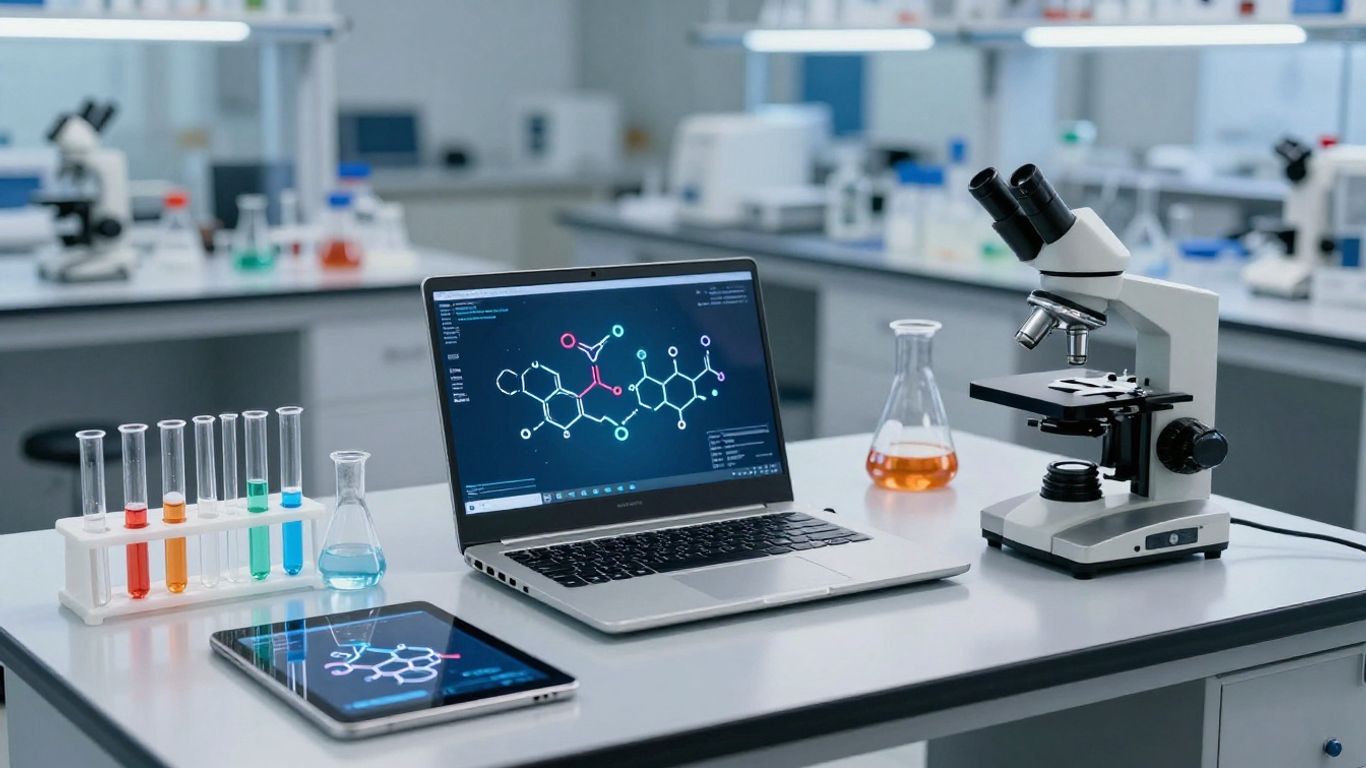
In today’s scientific world, technology isn’t just an add-on; it’s woven into the fabric of how we conduct research and learn. Bringing the right digital tools into your lab can really change how you approach experiments and analyze results. It’s about making things more efficient, accurate, and sometimes, even safer.
Data Collection and Research Tools
Computers and tablets have become indispensable. They’re not just for typing up reports anymore. Think about using them to directly collect data from sensors during an experiment. This means you can get real-time readings for things like temperature, pressure, or even light intensity. Plus, having a good internet connection means you can quickly access vast online databases for background research or to compare your findings with published studies. It cuts down on a lot of manual work and potential for transcription errors.
Here’s a quick look at some common tools:
- Data Loggers: Devices that automatically record measurements over time.
- Tablets/Laptops: For controlling experiments, viewing data, and accessing information.
- Specialized Software: Programs designed for specific data analysis or experimental control.
Interactive Learning Displays
For teaching or collaborative environments, interactive whiteboards or large touch-screen displays can be a game-changer. Instead of just pointing at a static diagram, you can manipulate models, draw out reaction mechanisms, or even display live data feeds from ongoing experiments. This makes complex concepts much easier to grasp and encourages active participation from students or colleagues. It turns passive observation into an engaging experience.
Simulation and Virtual Experimentation Software
Sometimes, performing a physical experiment isn’t practical or safe. Maybe the chemicals are too hazardous, the equipment too expensive, or the process takes too long. This is where simulation software shines. You can run virtual experiments, test different variables, and see the outcomes without any real-world risk or cost. It’s a fantastic way to learn the principles of an experiment before you ever step into a physical lab, or to explore scenarios that would be impossible otherwise.
Using simulation software can help researchers and students develop a better feel for how experiments work. It allows for trial and error in a consequence-free environment, which can build confidence and a deeper understanding of the underlying scientific principles before committing to physical resources.
This integration of technology helps make science more accessible, efficient, and dynamic. It’s about using the best tools available to push the boundaries of discovery and learning.
Making your science lab more high-tech can really boost learning. Imagine using cool new tools to explore and understand concepts better. Ready to see how modern gadgets can transform your classroom experiments? Visit our website today to discover the latest in lab technology and find the perfect tools to inspire your students!
Wrapping Up Your Lab Setup
So, getting your lab ready for experiments isn’t just about grabbing a bunch of stuff. It’s really about setting up a good space where people can learn and figure things out. When you focus on keeping things tidy, using decent tools, and maybe even adding some tech, you’re building a solid base for new ideas and teaching. It?s the groundwork for discoveries that could really make a difference.
Frequently Asked Questions
What are the most basic tools needed for any science experiment?
For almost any science experiment, you’ll need basic tools like beakers, flasks, and test tubes for holding and mixing liquids. You’ll also need ways to measure things accurately, such as digital scales for weighing solids and tools like graduated cylinders or pipettes for measuring liquids. Don’t forget safety gear like goggles and gloves!
Why is accurate measurement so important in science?
In science, being precise is key to getting reliable results. If your measurements are off, even by a little, your entire experiment could lead to the wrong conclusions. Think of it like baking a cake; if you use too much or too little of an ingredient, the cake might not turn out right. Accurate tools help ensure your scientific ‘recipe’ is correct.
What safety equipment should always be present in a lab?
Safety first! Every lab must have personal protective gear, which includes things like safety goggles to protect your eyes, lab coats to keep your clothes clean and safe, and gloves to protect your skin. It’s also important to have emergency equipment ready, such as eyewash stations, safety showers, and fire extinguishers, just in case something goes wrong.
Are there special tools for more advanced science work?
Yes, for more complex research, scientists use specialized equipment. Microscopes are used to see tiny things, incubators provide controlled environments to grow cells, and spectrometers help analyze the properties of light or matter. These tools allow for deeper exploration and more detailed analysis.
How can technology help in a science lab?
Technology can make science experiments more efficient and engaging. Computers and tablets can be used to record data, research information, or even run simulations of experiments. Interactive displays can help teachers explain concepts, and special software can let students explore scientific ideas in a virtual space, which is often safer and more accessible.
Is it better to buy new or used lab equipment?
Both new and used equipment can work well. New equipment is often up-to-date and comes with a warranty. However, used equipment, if it’s been checked and is in good condition, can be a much more affordable option, especially for labs with smaller budgets. The most important thing is that the equipment is reliable and accurate, no matter if it’s new or pre-owned.