
Peptide Storage Best Practices: A Guide for Australian Researchers (2026)
By Peak Haven15 min read

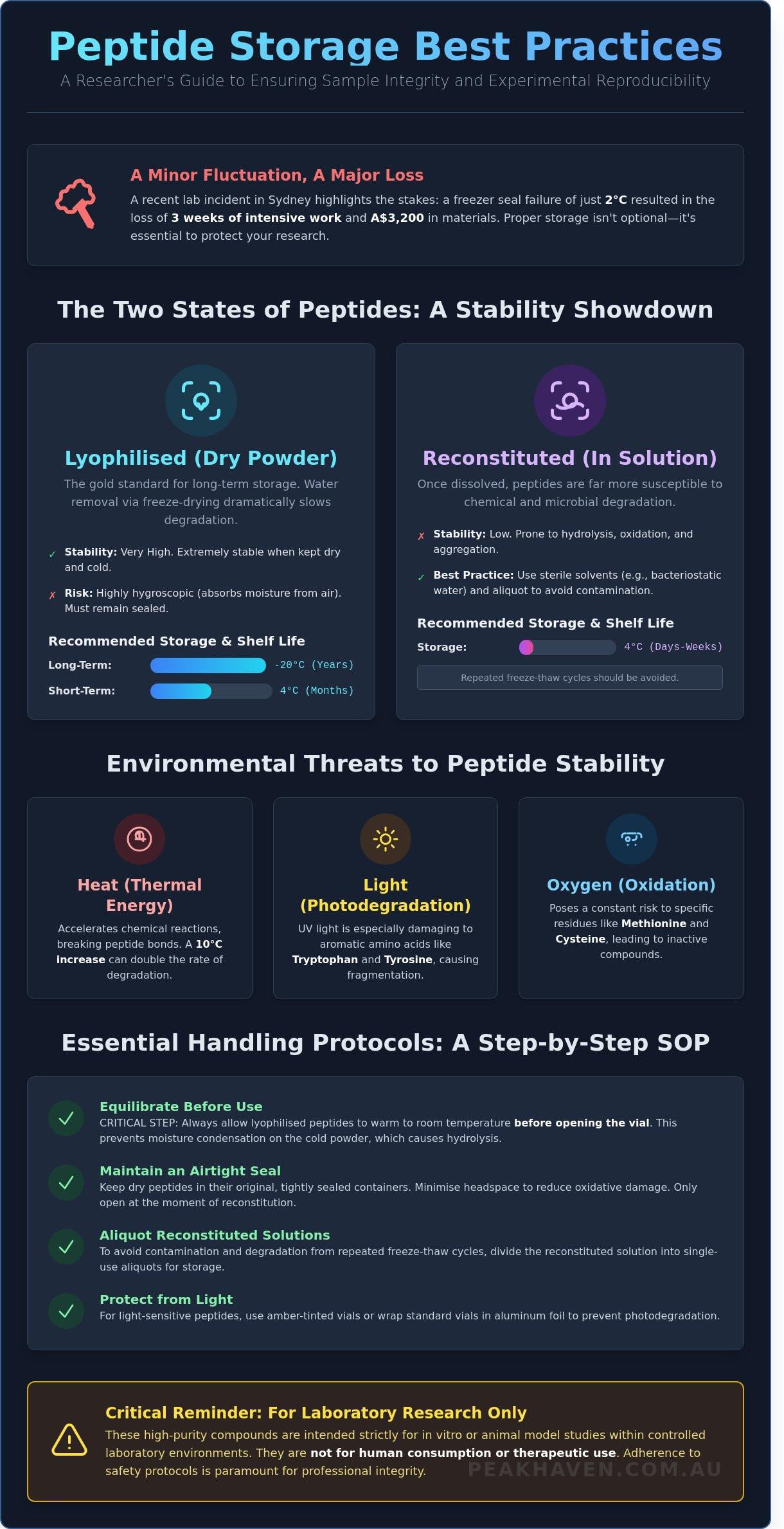
Last Tuesday, a lead researcher in Sydney discovered that three weeks of intensive work and A$3,200 in high-purity materials were lost because a freezer seal failed by just two degrees. It’s a heartbreaking reality in Australian labs where delicate compounds are often at the mercy of minor environmental fluctuations. You likely already know that protecting your investment starts with mastering peptide storage best practices to avoid these costly setbacks and ensure your data remains valid. We believe your focus should stay on your next breakthrough, not on the underlying anxiety of whether your samples will survive the night in the lab.
We understand the frustration of seeing inconsistent experimental results that stem from degraded materials rather than your actual hypothesis. It’s our goal to help you regain control over your resources and your time. This guide provides you with the essential protocols for preserving peptide stability and ensuring experimental reproducibility in your laboratory. We’ll explore specific environmental degradation factors, the clear shelf-life differences between lyophilised and reconstituted forms, and the exact steps needed to maintain long-term compound integrity. By following these 2026 standards, you can secure your research journey and focus on the outcomes that truly matter.
Key Takeaways
- Protect the integrity of your delicate research samples by understanding the specific degradation pathways that can compromise your experimental results.
- Learn to distinguish between short-term refrigeration and long-term deep-freeze requirements to ensure your lyophilised peptides remain stable for the duration of your study.
- Master **peptide storage best practices** for reconstituted solutions, including how to use bacteriostatic water to maintain a sterile and effective research environment.
- Identify and mitigate environmental risks such as light sensitivity and mechanical stress through simple, protective laboratory handling techniques.
- Implement a clear Standard Operating Procedure (SOP) to streamline your laboratory workflow and ensure every compound is handled with care from the moment it arrives.
Understanding Peptide Stability: Why Correct Storage is Vital
Peptides are the backbone of modern laboratory inquiry. They aren’t just simple substances; they’re delicate biomolecules held together by sensitive peptide bonds. When you understand the intricate peptide structure and chemistry, you begin to see why stability is so fragile. If these bonds are compromised, your entire research project faces risks. Degradation isn’t just a minor change. It involves complex pathways like hydrolysis, where water molecules break the chain, or oxidation, which alters the chemical identity of the compound. Physical aggregation is another hurdle, where peptides clump together and lose their functional shape.
To better understand this concept, watch this helpful video:
When stability fails, the secondary structure of the molecule collapses. This means the biological activity you’re trying to measure in your trials might vanish or become unpredictable. In a 2024 study of synthetic compounds, even a 5% degradation rate led to significant inconsistencies in bioassay results. Your data depends on the integrity of the sequence. Some peptides are naturally more resilient, while others are incredibly sensitive due to their specific sequence composition. Following peptide storage best practices ensures that your journey toward discovery remains on track and your results stay reliable.
The Three Main Threats: Heat, Light, and Oxygen
Thermal energy is a primary enemy in the lab. Heat provides the kinetic energy needed to accelerate chemical reactions that break down bonds. A 10?C increase in temperature can often double the rate of chemical breakdown. Photodegradation is equally concerning. UV light is particularly damaging to aromatic amino acids like tyrosine and tryptophan, causing them to fragment. Finally, oxidative stress poses a constant risk to methionine and cysteine residues. These specific amino acids can react with trace amounts of oxygen, leading to inactive sulfoxides that compromise your peptide storage best practices.
Laboratory Use Only: A Critical Reminder
It’s vital to remember that these protocols apply strictly to peptides for laboratory research. These compounds are intended for in vitro or animal model studies within controlled environments. They aren’t for human consumption or therapeutic use. Maintaining high-purity standards is about more than just data; it’s about professional integrity and safety. We encourage all Australian researchers to standardise their safety protocols when handling these high-purity compounds. This collaborative approach to safety ensures your laboratory remains a place of precise, ethical science.
Best Practices for Lyophilised (Dry) Peptide Storage
Lyophilisation, or freeze-drying, stands as the gold standard for maintaining the integrity of your research materials. By removing water through sublimation, this process creates a stable, powdery state that resists the chemical reactions that typically lead to degradation. To ensure your samples remain viable for your specific research goals, you’ll need to follow strict peptide storage best practices regarding environment and handling.
These dry powders are highly hygroscopic. This means they eagerly absorb moisture from the surrounding air. Even a brief exposure to Australian humidity can trigger hydrolysis, a process that breaks down peptide bonds and ruins your sample. It’s vital to keep your compounds in their original, airtight vials until the exact moment of use. According to the NIBSC peptide storage protocols, choosing the right container and minimising headspace is essential for preventing oxidative damage and maintaining purity levels above 95%.
The Critical Equilibration Step
Opening a vial the moment you take it out of the freezer is a mistake that can ruin an entire batch. When cold glass meets warmer air, condensation forms instantly inside the vial. This moisture creates a micro-environment where the peptide begins to break down. You must allow the vial to reach room temperature before breaking the seal. Place the vial in a desiccator for 30 to 60 minutes. This simple habit protects your investment and ensures your results remain consistent across every stage of your project.
Temperature Zones and Longevity
Your storage choice depends on how quickly you plan to use the material. For compounds in active weekly use, a standard refrigerator set to 4°C is sufficient for 1 to 3 months. If you have a larger stock intended for use over 12 to 24 months, a deep freeze at -20°C or -80°C is necessary. While dry peptides are stable at room temperature for roughly 2 to 4 weeks if kept dark, this is only suitable for immediate transport or short-term transit.
For researchers managing complex schedules, having a reliable system makes all the difference. Just as we help individuals navigate their NDIS support journey with clarity, we encourage you to build a structured log for your storage temperatures. This ensures you maintain total choice and control over the quality of your research materials.
Handling Reconstituted Peptides: Stability in Solution
Reconstituting a peptide is a pivotal moment in your research journey. Once you introduce a solvent, the peptide transitions from a stable, freeze-dried state to a much more vulnerable liquid form. In this state, the delicate bonds holding the amino acids together are exposed to degradation through hydrolysis and oxidation. Following peptide storage best practices ensures your samples maintain their integrity for the duration of your study. Liquid peptides are significantly more fragile because the water molecules allow for greater chemical reactivity and molecular movement, which can lead to rapid unfolding or aggregation.
Most researchers in Australia prefer using bacteriostatic water because it contains 0.9% benzyl alcohol. This additive is vital for suppressing microbial growth, especially if you need to draw from the same vial over several days. You should also consider the pH of your solvent. Peptides are often most stable at a slightly acidic pH, typically between 4.0 and 6.0. A pH that is too high or too low can cause the peptide to precipitate or break down. We strongly advise against repeated freeze-thaw cycles. Every time a liquid peptide freezes and thaws, the physical stress of ice crystal formation can shear the molecular structure, potentially reducing potency by 25% or more in a single cycle.
The Aliquoting Strategy
To protect your research, we recommend the aliquoting strategy. This involves dividing your reconstituted peptide into smaller, single-use portions immediately after mixing. By using sterile, medical-grade polypropylene vials, you ensure that you only thaw exactly what you need for a single session. This method eliminates the thermal stress of cooling the entire batch repeatedly and significantly reduces the risk of accidental contamination. You can find more detailed Peptide storage and handling guidelines from international standards organizations to help you refine your laboratory protocols and ensure consistency across your team’s work.
Storage Durability for Common Compounds
Different compounds have unique needs. For example, BPC-157 research suggests this pentadecapeptide is relatively robust, but it still requires refrigeration at 2?C to 8?C once in solution. In contrast, sensitive growth factor analogues and GLP-1 research peptides are much more fragile. These often lose significant activity if left at room temperature for more than 120 minutes. As a general rule for Australian laboratories, reconstituted peptides should be used within 14 to 21 days when stored in a standard laboratory refrigerator. Adhering to these peptide storage best practices helps you achieve more reliable and reproducible results in your scientific pursuits.
Environmental Threats: Managing Your Lab Environment
Your laboratory environment acts as the foundation for your research success. Protecting your sequences from invisible threats requires a proactive approach to peptide storage best practices. Light sensitivity is a primary concern for sequences containing tryptophan, tyrosine, or cysteine. Exposure to UV rays can trigger photolysis, which degrades your sample’s purity by up to 12% in a single afternoon. We recommend using amber glass vials or wrapping clear containers in high-grade aluminium foil to create a protective barrier.
Mechanical stress is another often overlooked factor. Vigorous shaking can lead to the aggregation of delicate peptide chains, potentially ruining a batch worth A$650 or more. Instead, use a gentle swirling motion during reconstitution to preserve the molecular structure. Maintaining a sterile field is equally vital. Use a laminar flow hood to prevent microbial contamination that can introduce proteases into your sample. Reliable monitoring is non-negotiable; your research freezer should have a calibrated thermometer with an accuracy of plus or minus 0.1 degrees Celsius. This precision ensures you catch fluctuations before they impact your study’s integrity.
- Light Management: Use opaque storage boxes and amber vials for all light-sensitive sequences.
- Vibration Control: Place freezers away from heavy machinery or high-traffic zones to minimise micro-vibrations.
- Contamination: Always use sterile, DNAse/RNAse-free tips and tubes during every sampling step.
Avoiding the Auto-Defrost Trap
Domestic “frost-free” freezers are unsuitable for scientific storage. These units use a heating element to melt ice, causing internal temperature spikes of up to 15 degrees Celsius during each cycle. For peptides, these fluctuations lead to repeated freeze-thaw events at a molecular level, even if the liquid appears frozen. A dedicated manual-defrost laboratory freezer maintains a steady environment. This investment protects the integrity of your work and prevents the silent degradation of your most valuable assets.
Organising Your Peptide Library
An efficient library prevents waste and ensures every step of your journey is documented. Implement a First-In, First-Out (FIFO) system to use older batches before their 12-month stability window closes. Every vial should clearly list the receipt date, reconstitution date, and exact concentration. Digital logs provide a transparent history of your storage conditions. This is essential for meeting Australian regulatory requirements and ensuring your results are reproducible for future peer reviews.
If you’re looking for a partner to help you manage the complexities of your research environment or support services, discover how we can help you reach your highest potential and goals.
Ensuring Longevity: A Checklist for Your Laboratory Workflow
When your shipment arrives at your facility, the first 60 seconds are critical for maintaining the integrity of your research. You should inspect the package immediately for seal integrity and check any included cold-chain indicators. In the Australian climate, where ambient temperatures can fluctuate rapidly, verifying that your compounds remained within the required thermal range during transit is your first line of defense. If you notice any compromised packaging or unexpected moisture, document these findings before placing the vials into long-term storage.
Establishing a clear Standard Operating Procedure (SOP) helps your team maintain consistency. We recommend a “bench-to-freezer” policy where vials spend no more than 5 minutes outside of controlled temperatures. This practice is a cornerstone of peptide storage best practices because it minimizes the risk of moisture condensation and thermal degradation. When a compound is no longer viable or has passed its documented shelf life, follow your institution’s biohazardous waste protocols. This usually involves neutralizing the material and disposing of it through certified Australian chemical waste services to ensure environmental safety.
The Peak Haven Quality Commitment
We believe your research deserves a foundation of absolute certainty. That’s why every compound we offer undergoes rigorous HPLC testing to confirm purity levels often exceeding 98%. Our shipping methods are specifically designed for the Australian landscape. We use reinforced, insulated packaging that protects your materials from the harsh sun and transit delays. You’re never alone in your work; we provide direct access to technical support to help you navigate specific handling challenges or complex reconstitution requirements.
Final Summary Checklist
To help you achieve the most reliable results in your studies, we’ve compiled this essential peptide storage best practices checklist. Following these steps will help protect your investment and the validity of your data.
- Freeze for stability: Store lyophilised peptides at -20?C for maximum duration; for studies lasting over a year, -80?C is preferred.
- Prevent condensation: Always allow vials to equilibrate to room temperature in a desiccator before opening the seal.
- Protect the chain: Aliquot reconstituted solutions into single-use volumes to avoid the damaging effects of repeated freeze-thaw cycles.
- Stay informed: Contact Peak Haven for bulk procurement and wholesale handling advice tailored to your specific lab needs.
By integrating these steps into your daily routine, you create a stable environment for your research to flourish. It’s about more than just chemicals; it’s about the care and precision you bring to your journey of discovery.
Empowering Your Research Journey in 2026
Success in the laboratory starts with the integrity of your materials. By implementing these peptide storage best practices, you’re protecting your time and your data. Remember to prioritize lyophilised storage at -20?C for long-term stability and ensure your reconstituted solutions are aliquoted to avoid repeated freeze-thaw cycles. These small, disciplined steps create a reliable foundation for your scientific breakthroughs. Our 2026 guide highlights that even a 5-degree fluctuation can compromise sensitive sequences, so maintaining a stable environment is paramount.
At Peak Haven, we’re your dedicated partner in this pursuit. We provide facility-grade laboratory supplies and ensure 100% of our batches undergo third-party HPLC testing to verify purity before they reach your bench. We understand that your research can’t wait; that’s why we offer fast Australia-wide express shipping on all orders. You deserve a steady hand and a reliable source as you navigate the complexities of modern research standards. We take pride in being the bridge between your ambitious goals and the high-quality resources required to achieve them.
Explore our HPLC-verified research peptide catalogue
Your goals are within reach, and we’re here to help you reach your highest potential. Let’s build a future of discovery together.
Frequently Asked Questions
How long do lyophilised peptides last in the freezer?
Lyophilised peptides typically remain stable for up to 24 months when you store them in a standard laboratory freezer at -20?C. For long-term preservation, moving them to a -80?C deep freezer can extend their shelf life to 60 months or more. It’s vital to keep the vials in an airtight container with desiccant packs to prevent moisture from entering, as humidity is the primary cause of degradation in powdered samples.
Can I store peptides in a regular kitchen fridge?
You can store peptides in a domestic fridge at 4?C for short periods, generally between 4 and 12 weeks. While this works for active projects, kitchen fridges often have temperature fluctuations of 3 to 5 degrees during their automatic defrost cycles. We recommend using a dedicated laboratory fridge to ensure your samples remain stable and effective for your specific Australian research goals.
What happens if a peptide is left at room temperature for a few days?
Most lyophilised peptides can withstand room temperature for 3 to 7 days without losing more than 1% of their purity. However, once you’ve reconstituted them into a liquid, degradation happens much faster, often within 24 hours at 25?C. If your shipment was delayed in the Australian summer heat, testing the purity via HPLC is a reliable way to confirm the sample’s integrity before you proceed with your work.
Why do I need to let the vial reach room temperature before opening?
You must let the vial sit at room temperature for at least 30 to 60 minutes to prevent atmospheric moisture from condensing inside the tube. If you open a cold vial, water vapour from the air immediately binds to the peptide powder. This moisture triggers hydrolysis, which can ruin your peptide storage best practices and reduce the compound’s potency by 15% or more in a single event.
Is it better to store peptides as a powder or a liquid?
Storing peptides as a lyophilised powder is always the superior choice for maintaining long-term stability and potency. In powder form, the molecules are far less reactive and can last for 730 days in a freezer environment. Once you add a solvent like bacteriostatic water, the peptide begins to break down, typically losing significant activity within 14 to 30 days even when kept refrigerated.
How can I tell if my peptide has degraded?
You can identify degradation through visual changes like cloudiness, discolouration, or the presence of insoluble particles after you’ve reconstituted the powder. While these signs are helpful, the only definitive method is performing High-Performance Liquid Chromatography (HPLC) to check if the purity has dropped below the 95% threshold. If your solution looks milky or has floating precipitates, it’s likely the peptide has denatured and won’t yield reliable results.
Does light really affect peptide stability?
Yes, UV light and even standard fluorescent office lighting can cause photolysis, which breaks the delicate chemical bonds in your sample. This is particularly true for peptides containing amino acids like tryptophan or tyrosine which are sensitive to light energy. To protect your investment, store your vials in an opaque box or wrap them in aluminium foil, which blocks 100% of light exposure and ensures your research journey stays on track.
Can I refreeze a peptide after it has been reconstituted?
We strongly advise against refreezing a peptide once it’s in liquid form because the process of ice crystal formation can shear the molecular chains. Repeated freeze-thaw cycles can reduce the biological activity of your sample by 20% during each cycle. Instead, divide your solution into small 0.5ml aliquots so you only thaw the exact amount you need for each stage of your study, giving you more control over your resources.

Disclaimer
The products discussed in this article are intended strictly for laboratory and research purposes only. They are not intended for human consumption, therapeutic use, or as dietary supplements. Nothing in this article should be interpreted as medical advice, a diagnosis, or a recommendation for treatment. Always consult a qualified healthcare professional for any medical concerns.
Peak Haven supplies research-grade peptides exclusively for scientific and clinical research use. All products undergo independent third-party HPLC testing to verify purity and composition. By purchasing from Peak Haven, you confirm that products will be used solely for legitimate research purposes in accordance with all applicable Australian laws and regulations.
The information presented in this article is based on published scientific literature and is provided for educational purposes only. Peak Haven makes no claims regarding the efficacy or safety of any compound for human use. Individual research results may vary. References to studies or research findings do not constitute endorsement of any specific application.