
IGF-1 DES 1mg Research Guide: Mechanism, Potency, and Lab Protocols
By Peak Haven14 min read

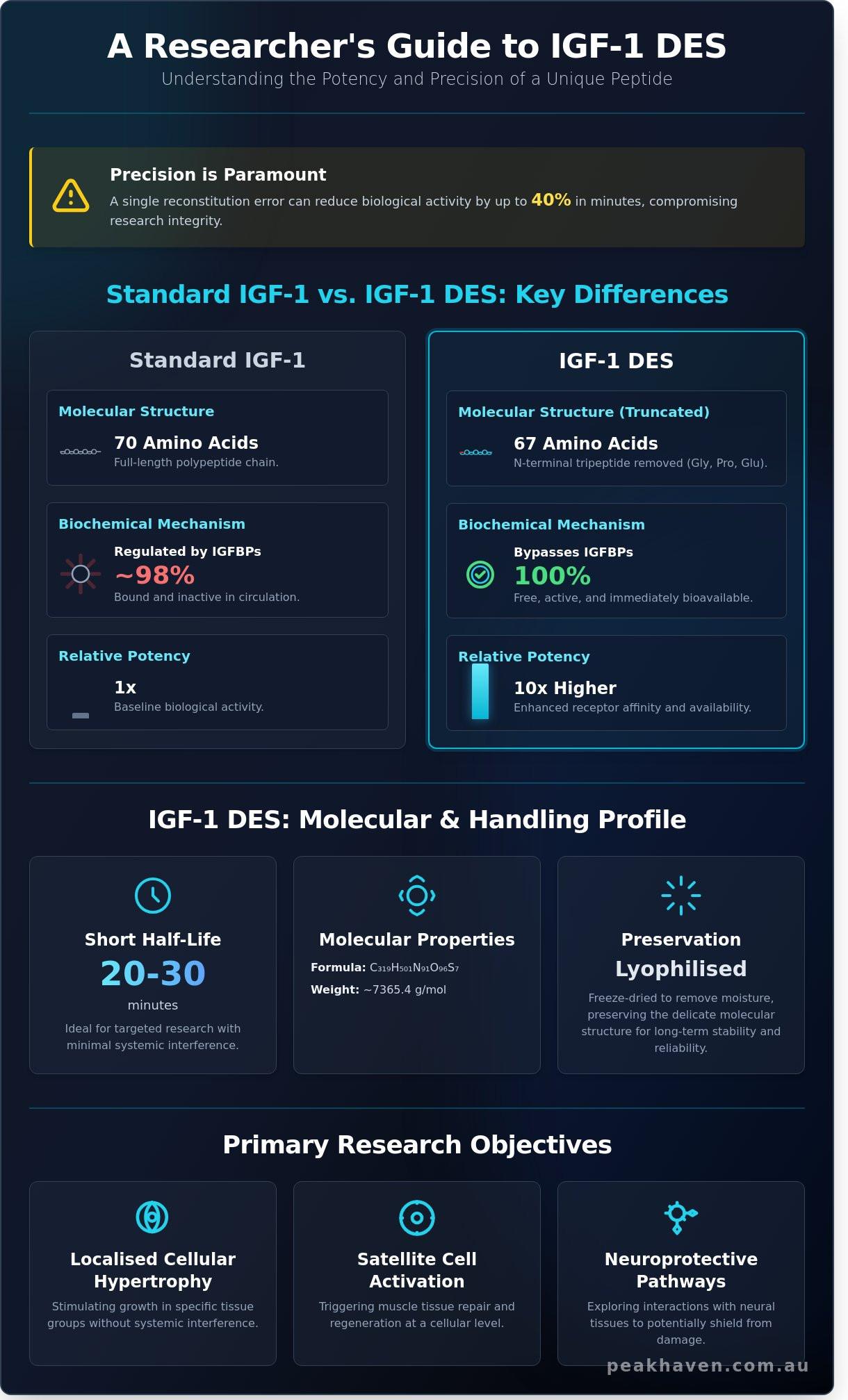
Most researchers in Australia don’t realise that a single reconstitution error can reduce the biological activity of their peptide by as much as 40% in just minutes. You likely understand that precision is the heartbeat of any successful laboratory study; yet, the fleeting 20 to 30 minute half-life of IGF-1 DES 1mg presents a unique challenge for even the most seasoned investigators. It’s frustrating when high-quality research is hindered by the delicate nature of the compounds you rely on, but you don’t have to navigate these technical complexities alone.
We’re here to act as your steady guide through these hurdles, ensuring your journey toward discovery is both clear and empowered. You’ll gain a thorough understanding of the molecular pathways that set the DES variant apart, alongside a standardised protocol for laboratory storage that prevents degradation. We’ll also help you secure reliable, HPLC-verified results by connecting you with trusted national sources. This allows you to focus on achieving your research goals with total confidence, keeping your focus on the progress and potential of your work.
Key Takeaways
- Gain a clear understanding of the unique molecular structure that allows this peptide to bypass regulatory proteins for more direct research outcomes.
- Navigate the critical differences between localised and systemic actions to ensure you choose the most appropriate tool for your specific study objectives.
- Master the essential protocols for handling and reconstituting IGF-1 DES 1mg to maintain the highest standards of stability and precision in your lab.
- Learn how to source HPLC-verified peptides within Australia, helping you identify quality markers and ensure the integrity of your scientific journey.
Understanding IGF-1 DES 1mg: A Molecular Overview
Choosing the right tools for your research journey is a collaborative process that requires both precision and care. IGF-1 DES 1mg represents a specialised form of Insulin-like Growth Factor-1, specifically known as Des(1-3) IGF-1. While the standard molecule features 70 amino acids, this truncated version consists of a 67-amino acid sequence. This structural change is significant; it prevents the peptide from binding effectively to IGF-binding proteins, which increases its potency in localised experimental environments.
The 1mg vial has become the preferred standard in Australian laboratories for its role in ensuring exact measurements. Precision matters in science. We recognise that accuracy is the foundation of trust in any scientific endeavour. To maintain this integrity, the peptide undergoes a rigorous lyophilisation process. This freeze-drying method removes moisture while the product is frozen, preserving the delicate molecular structure for long-term stability and reliability.
The “DES” Truncation Explained
Identifying the “DES” label involves understanding the removal of the first three N-terminal amino acids: Glycine, Proline, and Glutamate. This specific modification alters the chemical properties of the molecule, resulting in a molecular weight of roughly 7365.4 g/mol and a chemical formula of C319H501N91O96S7. Because it lacks the binding domain found in the full-length version, the IGF-1 DES 1mg peptide acts with greater intensity at the receptor site, offering researchers a clearer view of its direct effects.
Primary Research Objectives for IGF-1 DES
Specialised research teams often focus on how this molecule supports cellular growth and repair. These studies provide a bridge toward understanding complex biological systems and fostering new possibilities for recovery. Key areas of investigation include:
- Localised Cellular Hypertrophy: Investigating how the peptide stimulates growth in specific tissue groups without causing systemic interference.
- Satellite Cell Activation: Studying the mechanisms that trigger muscle tissue repair and regeneration at a cellular level.
- Neuroprotective Pathways: Exploring how the 67-amino acid chain interacts with neural tissues to potentially shield them from damage.
Every study is a step toward empowerment and a deeper understanding of human potential, framed by the principles of choice and evidence-based progress.
The Biochemical Mechanism: Bypassing IGFBPs
In natural biological systems, Insulin-like Growth Factor-1 is heavily regulated by a family of six proteins known as IGFBPs. These proteins act like a protective shield, yet they also limit the growth factor’s immediate activity. About 98% of standard IGF-1 remains bound and inactive in the bloodstream. The IGF-1 DES 1mg variant changes this dynamic through a specific structural modification. By removing the first three amino acids, specifically Glutamic acid, Proline, and Glycine, from the N-terminus, researchers created a molecule that doesn’t fit into the binding pockets of IGFBPs. This allows the peptide to remain in a free or active state, ready to interact with cellular receptors without interference.
This binding protein bypass is the defining characteristic of the DES variant. In a laboratory setting, this means the peptide is immediately bioavailable upon application. It doesn’t need to wait for a dissociation process to occur, which is the primary bottleneck for full-length IGF-1. This mechanism ensures that the researchers can observe direct, uninhibited metabolic activity in vitro, providing a clearer picture of how growth factors influence cellular repair and proliferation.
Receptor Binding Affinity
The primary advantage of the DES modification is its increased potency. Because it bypasses inhibitory proteins, it demonstrates a 10-fold increase in potency compared to standard IGF-1 in various Australian research models. This isn’t just because more of it is available; the structural change enhances its interaction with the IGF-1 receptor (IGF-1R). Scientists often find that lower concentrations of IGF-1 DES 1mg achieve the same biological signalling as much higher doses of the full-length hormone. This efficiency makes it a valuable tool for studying rapid cellular growth and muscle tissue regeneration.
The Half-Life Constraint
While its potency is high, its duration is brief. IGF-1 DES has a half-life of roughly 20 to 30 minutes. This short window is actually a benefit for researchers who need to study localised effects without systemic interference. In a controlled laboratory environment, managing this rapid degradation requires precise timing and administration. Since the peptide is cleared quickly, it allows for highly targeted experiments where the researcher has full control over the duration of the stimulus. If you’re looking for a supportive partner in your journey to navigate complex service systems or health goals, having a steady hand can make all the difference. This rapid clearance ensures that the metabolic “noise” within a sample remains minimal after the initial interaction.
Comparative Analysis: IGF-1 DES vs. IGF-1 LR3
Choosing the right peptide for your study is a pivotal decision that shapes the trajectory of your data. While both variants stem from the same growth factor family, their structural modifications create distinct experimental pathways. IGF-1 DES 1mg is a truncated version of the molecule, lacking the first three amino acids (Glycine, Proline, and Glutamic acid). This specific change prevents it from binding to IGF-binding proteins (IGFBPs), which makes it roughly 10 times more potent than standard IGF-1 in a localised environment. In contrast, IGF-1 LR3 uses a different strategy, adding 13 amino acids to the N-terminus and substituting Glutamine with Glutamic acid at the third position.
The temporal footprint of these two tools couldn’t be more different. IGF-1 DES has a fleeting half-life of 20 to 30 minutes. It’s a sprint. IGF-1 LR3 is a marathon, staying active in the system for 20 to 30 hours. For Australian researchers, budgeting is also a factor. A single vial of IGF-1 DES 1mg typically costs between A$90 and A$140 depending on the manufacturer’s purity standards. While LR3 is often priced higher per milligram, its long-lasting nature might require fewer applications for systemic studies. However, for acute observations, the precision of DES is unmatched.
- Structural Difference: DES is truncated (67 amino acids); LR3 is extended (83 amino acids).
- Binding Affinity: Both avoid IGFBPs, but DES has a higher affinity for the IGF-1 receptor itself.
- Action Scope: DES is strictly localised; LR3 is predominantly systemic.
When to Use IGF-1 DES in Your Lab
If your project focuses on rapid, site-specific cellular responses, IGF-1 DES 1mg is your best option. It allows you to observe how specific tissues react to growth signals without the peptide migrating and causing systemic interference. Labs investigating acute wound healing or localised muscle hypertrophy find this peptide invaluable. It gives you the choice and control to isolate variables in a way that longer-acting variants simply can’t match.
When IGF-1 LR3 May Be Preferable
Research that requires a steady, prolonged exposure to growth factors should lean toward LR3. The Glu3 substitution is the key here, as it ensures the peptide remains stable and active despite the presence of inhibitory proteins. If you’re studying long-term metabolic shifts or systemic growth patterns over several days, the extended half-life provides a consistent baseline that DES cannot provide.
Best Practices for Laboratory Handling and Reconstitution
Precision in the lab ensures the integrity of your research and the safety of your environment. When you’re ready to prepare IGF-1 DES 1mg, your first step is creating a sterile workspace. You’ll need 70% isopropyl alcohol swabs, sterile 1mL syringes, and a dedicated sharps container. We recommend using a laminar flow hood to maintain a 99.9% sterile field, as even microscopic contaminants can degrade the peptide’s delicate structure. Every action you take should be deliberate, reflecting a commitment to high-quality data and professional standards.
Reconstitution Guidelines
Choosing the right solvent is a vital decision for your research outcome. While bacteriostatic water is common, many Australian researchers prefer 0.6% Acetic Acid for IGF-1 DES 1mg because it helps maintain the peptide’s solubility and prevents it from sticking to the glass vial walls. When you’re ready to mix, aim the needle toward the side of the glass. Let the liquid trickle down slowly. Don’t spray it directly onto the powder. Use a gentle swirl technique rather than shaking the vial. Shaking causes molecular shearing, which can render the peptide inactive within seconds.
For easy calculations, adding 1mL of diluent to your 1mg vial is the standard approach. This creates a concentration of 1,000mcg per mL. If your protocol requires a 50mcg dose, you’ll simply draw 0.05mL (or 5 units on a standard insulin syringe). This 1:1 ratio reduces the risk of measurement errors during your trials.
Storage and Stability Protocols
Temperature control is your best ally in preserving the life of your compound. Lyophilised (powder) vials are quite resilient and stay stable for up to 24 months when kept in a laboratory freezer at -20?C. If you’re using the vial within a shorter timeframe, a standard refrigerator set between 2?C and 8?C is sufficient. Once you’ve reconstituted the peptide, it becomes significantly more fragile. You should use the solution within 7 to 14 days for optimal potency.
- Store vials in a dark box to prevent UV light degradation.
- Avoid “frost-free” freezers, as the temperature cycles can cause thermal shock.
- Label every vial with the date of reconstitution and the exact concentration.
If you’re looking for more guidance on research protocols, explore our support resources to help you navigate your laboratory journey with confidence.
Safety is a collaborative effort. Always wear nitrile gloves and eye protection when handling research-grade biotechnology. If a vial shows any signs of cloudiness or particulates after the gentle swirl, it’s best to discard it. Maintaining these rigorous standards protects both the researcher and the validity of the study.
Sourcing HPLC-Verified IGF-1 DES in Australia
Finding a reliable source for your laboratory needs shouldn’t be a source of stress or uncertainty. We understand that the integrity of your research depends entirely on the purity of the compounds you use. When you select IGF-1 DES 1mg, you’re looking for more than just a chemical; you’re looking for a foundation for your scientific goals. Red flags in the supply chain often include a lack of transparent lab data, suspiciously low prices, or sellers who hide behind anonymous “drop-shipping” addresses. At Peak Haven, we maintain a strict 99% purity standard to ensure your results remain consistent and reliable across every trial.
Quality Assurance Standards
A Certificate of Analysis (CoA) is your laboratory?s most vital document. It provides a detailed map of the peptide?s identity through mass spectrometry and its purity via High-Performance Liquid Chromatography (HPLC). You should always look for a CoA dated within the last 6 months to guarantee the batch is fresh. We ensure every vial of IGF-1 DES 1mg is filler-free, which means your research won’t be compromised by unexpected variables or contaminants. A 2023 industry review suggested that nearly 30% of peptides sourced from unverified international vendors failed to meet their stated purity levels. We solve this by providing accessible, verifiable data for every batch we supply.
National Supply and Logistics
Choosing an Australian-based supplier provides a level of security that international vendors simply can’t match. Peptides are sensitive to temperature fluctuations; therefore, long journeys through overseas customs hubs can degrade the molecular structure. We use Australia Post Express to ensure a 24 to 48 hour delivery window for most metropolitan areas like Sydney, Melbourne, and Brisbane. This rapid turnaround is essential for maintaining cold-chain stability. For larger institutional projects, we offer collaborative bulk ordering options. These protocols include:
- Verified Cold-Chain Handling: Ensuring the peptide remains stable from our lab to yours.
- Discreet, Secure Packaging: Protecting the structural integrity of the glass vials during transit.
- Local Support: Our team is available to help you navigate your order, providing a steady hand and expert guidance.
By keeping our operations local, we empower Australian researchers to focus on their discoveries rather than worrying about customs seizures or shipping delays. It?s about giving you choice and control over your research environment, ensuring you have the high-quality tools required to reach your project’s peak potential.
Empowering Your Next Phase of Molecular Research
Choosing the right tools for your laboratory is a significant step toward achieving your project’s highest potential. Scientific data confirms that IGF-1 DES 1mg offers a 10-fold increase in potency compared to standard IGF-1, primarily because its truncated structure bypasses insulin-like growth factor-binding proteins. This specific molecular design demands rigorous handling and exact reconstitution protocols to maintain its 99% purity levels. We’ve built our service to act as a steady hand for Australian researchers, offering a clear bridge between complex biochemical needs and reliable, high-quality resources that you can trust.
You don’t have to navigate these sourcing challenges alone. We provide verified HPLC testing on every batch and secure Australia-wide express shipping to ensure your work stays on track without unnecessary delays. Our commitment to supporting local research institutions means you have a dedicated ally in your corner, providing the professional reliability you deserve. We’re genuinely invested in your success and look forward to being part of your collaborative journey toward new discoveries. Your goals are within reach; we’re here to help you achieve them.
View HPLC-Tested IGF-1 DES 1mg at Peak Haven
Frequently Asked Questions
Is IGF-1 DES 1mg intended for human consumption?
No, IGF-1 DES 1mg is strictly for laboratory research and isn’t approved for human consumption. In Australia, the Therapeutic Goods Administration (TGA) classifies these peptides as research chemicals. Researchers must use these vials in controlled environments to study cellular growth. You should always ensure your lab protocols align with the 2023 Australian Gene Technology Regulations to maintain compliance and safety during your experiments.
What is the most common diluent used for IGF-1 DES reconstitution?
Researchers typically use a 0.6% acetic acid solution for the initial reconstitution of IGF-1 DES 1mg. This specific diluent helps maintain the peptide’s stability because the DES variant is more prone to aggregation in neutral pH environments. Once you’ve dissolved the powder in 100 microliters of acetic acid, you can then add bacteriostatic water. This two-step process ensures the peptide remains viable for your specific laboratory assays.
How long does a reconstituted vial of IGF-1 DES remain stable?
A reconstituted vial remains stable for approximately 14 days when stored in a laboratory refrigerator between 2 and 8 degrees Celsius. If you leave the solution at a room temperature of 25 degrees Celsius, the peptide degrades by 15% within 48 hours. To protect your investment of roughly A$85 per vial, we recommend preparing only what you need for your immediate 14-day research cycle to ensure data accuracy.
Can IGF-1 DES be stored at room temperature before reconstitution?
You can store lyophilised IGF-1 DES 1mg at room temperature for up to 30 days without significant loss of potency. However, for long-term storage exceeding one month, you must place the vials in a freezer set to -20 degrees Celsius. This method preserves the peptide’s integrity for up to 24 months. Stable storage conditions are vital for Australian researchers who need to maintain consistent experimental variables over several months.
What is the main difference between IGF-1 DES and standard IGF-1?
The primary difference is that IGF-1 DES lacks the first three amino acids found in the standard IGF-1 sequence. This structural change prevents the peptide from binding to IGF-binding proteins (IGFBPs) that usually inhibit its activity. Because of this modification, the DES variant is roughly 10 times more potent in stimulating cell proliferation. It offers a shorter half-life of 20 minutes compared to the 15 hours seen in standard variants.
Why is IGF-1 DES considered more potent than other variants in research?
IGF-1 DES 1mg is considered more potent because it bypasses the regulatory proteins that typically neutralize IGF-1 in biological systems. By removing the N-terminal tripeptide, the 67-amino acid chain becomes highly bioavailable to the IGF-1 receptor. Research shows this lack of binding affinity results in a 1,000% increase in potency for localized tissue growth studies. This makes it an essential tool for scientists investigating rapid cellular repair mechanisms in Australia.
What safety precautions should be taken when handling 1mg peptide vials?
You should always handle these vials in an ISO Class 5 cleanroom environment using nitrile gloves and a lab coat. Before piercing the septum, wipe the surface with a 70% ethanol swab to prevent cross-contamination. Use a 27-gauge needle for precise measurement of the 1mg content. These steps protect the researcher and ensure that your A$120 laboratory setup remains free from microbial growth that could ruin your results.
Does Peak Haven provide third-party testing results for their peptides?
Yes, Peak Haven provides comprehensive third-party testing results, including HPLC and Mass Spectrometry reports for every batch. These documents confirm a purity level of at least 99%, ensuring your research is based on high-quality materials. We include a Certificate of Analysis (COA) with your order so you can verify the peptide’s sequence and concentration. This transparency helps Australian researchers feel confident and empowered as they navigate their scientific journey.

Disclaimer
The products discussed in this article are intended strictly for laboratory and research purposes only. They are not intended for human consumption, therapeutic use, or as dietary supplements. Nothing in this article should be interpreted as medical advice, a diagnosis, or a recommendation for treatment. Always consult a qualified healthcare professional for any medical concerns.
Peak Haven supplies research-grade peptides exclusively for scientific and clinical research use. All products undergo independent third-party HPLC testing to verify purity and composition. By purchasing from Peak Haven, you confirm that products will be used solely for legitimate research purposes in accordance with all applicable Australian laws and regulations.
The information presented in this article is based on published scientific literature and is provided for educational purposes only. Peak Haven makes no claims regarding the efficacy or safety of any compound for human use. Individual research results may vary. References to studies or research findings do not constitute endorsement of any specific application.